



Seoul needs to get out of THAAD 'dilemma'









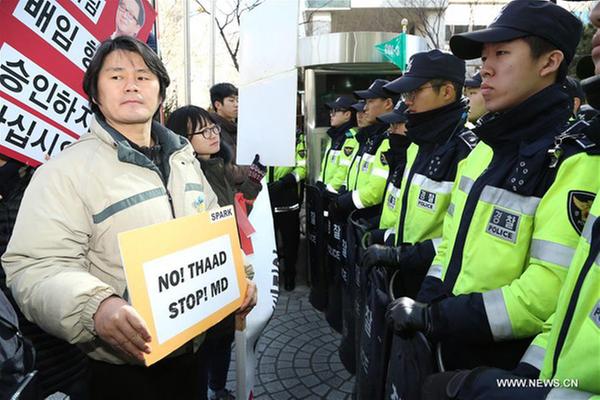 |
| People protest against the deployment of an advanced US missile defense system in front of the Lotte Headquarters in Seoul, South Korea, Feb 27, 2017. [Photo/Xinhua] |
There is a silver lining behind the cloud of relationship between China and the Republic of Korea, which has been sour since the latter decided to allow the US to deploy Terminal High Altitude Area Defense anti-missile system on its soil in July last year. During a strategic dialogue between foreign ministries on Tuesday, both countries voiced a willingness to improve bilateral ties.
China hoped the ROK would show the necessary political will and resolution to improve ties with China, State Councilor Yang Jiechi told ROK First Vice-Foreign Minister Lim Sung-nam on Tuesday. And the high-level strategic dialogue in Beijing between Lim and his Chinese counterpart Zhang Yesui reached an agreement that both sides need to maintain close communications on THAAD deployment.
It is difficult to evaluate the delay in the installation of THAAD after the ROK President Moon Jae-in ordered an environmental evaluation, because he reiterated that the THAAD decision made by his predecessor Park Geun-hye will be carried through. The decision to "delay" the THAAD rollout reportedly annoyed US President Donald Trump.
Perhaps Moon's diplomatic calculus is not about "trying to change the existing decision or sending a message to the United States". China demands a full withdrawal of THAAD from the ROK, but the Moon administration ordered to investigate the clandestine transportation of four more THAAD launchers and start environmental evaluation. The decision is nowhere near what Beijing desires, but still a good start of the ROK's softening stance.
Although impeached and ousted, Park had won the presidency and run the country legitimately, which could block attempts to overturn a critical decision made by her administration.
The secret shipment of four anti-missile launchers suggests the newly elected president hasn't been strong enough in his administration. And more importantly, he is not likely to terminate the THAAD "project" he had questioned on the presidential campaign.
The cause behind ordering a probe to delay the installation, on the other hand, is not hard to guess: the public opposition to THAAD, especially from residents of Seongju county where it is to be deployed, is a major factor for the Moon administration which enjoys an all-time high approval rating of 84 percent. And the price for not taking public opinion seriously is very high, as manifested in Park's removal.
A delay in THAAD's rollout also signals that Seoul wants to make its defense policy independent despite the fact that it needs US protection. Besides, Moon might find it unacceptable that the US rushed to deploy THAAD before he was elected one month ago.
The procedural flaws-that Park's decision to accommodate THAAD was not passed in the National Assembly-h(huán)as given Moon a chance to slow down the installation of THAAD and curb anti-THAAD sentiments at home. The delay, to some extent, has opened a window for China and the ROK to fix bilateral ties that have encountered economic turbulence after Seoul urged Washington to deploy the anti-missile shield in the ROK.
But a delay in installation is not the termination of the THAAD "project". Moon has to do more to show he is sincere about improving relations with Beijing and stabilizing the security situation in Northeast Asia. Both sides, however, have expressed willingness to communicate after Moon took office, and more people are traveling between the two countries, and ROK enterprises face less pressure in China.
Though the US administration is inclined to focus on domestic affairs, the disagreements between Washington and Seoul over THAAD may increase. The ongoing environmental assessment, as indicated by Washington's THAAD deployment in Guam, could take a year or more.
And through deft diplomatic maneuvering and candid high-level exchanges, China and the ROK could prevent tensions from intensifying while trying to find a way out of the THAAD "dilemma".
The author is an associate professor at Yanbian University, Jilin province.





