



Turning rags into riches









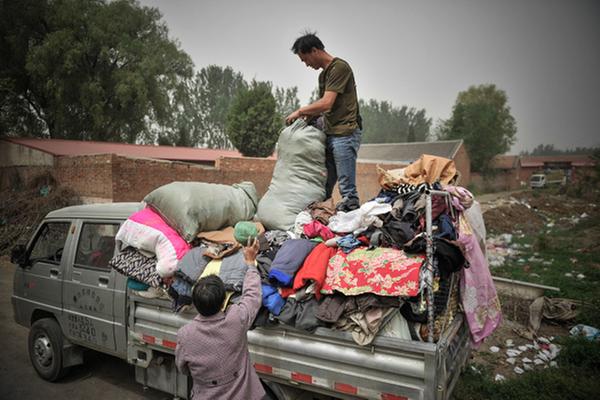 |
| Collectors load discarded clothing onto a van in Tianjin. YOU SIHANG/CHINA DAILY |
While companies, including e-commerce giants such as JD.com and Taobao, and a number of express delivery outfits, have joined efforts to collect used clothing, voluntary groups shoulder the lion's share of the work.
"We conducted a weeklong collection project from April 10 to 17," Zhuanzhuan's Liu said, adding that the project was well supported, with more than 38,000 people from 28 cities donating more than 37.2 tons of discarded clothing. On average, each participant offered 96 items.
"We plan to organize more events in the future," Liu said.
Ma Yun, founder of Feimayi, a Shanghai NGO that started in 2014, is concerned about finances: "Our charity won't last long if we cannot cover basic costs, such as those for collection, storing and sorting."
Feimayi has developed a method of dealing with the items it collects: 15 percent is exported, 10 percent is donated and the remainder is taken to recycling plants. "The exported clothes mainly go to African countries," Ma said.
Data from the Bureau of International Recycling in Brussels show that in many African countries, 80 percent of the population dresses in secondhand clothing, mainly imported from the US, European countries and China.
Recycling
According to Zhao, from the fashion technology institute, the biggest problem is recycling discarded clothing to produce yarns and other products: "Sales and donations account for a relatively small proportion of the work."
Beijing Huanwei Group, a leading waste-disposal company, has built a large processing center in Handan, Hebei province. The center will become operational soon, according to Li Shurun, who oversees the recycling division. In time, the annual recycling capacity will be expanded to 50,000 tons.
"We use advanced recycling technology, and have imported new machines to sort clothing. The process is more efficient and accurate than manual sorting," he said.
Using existing technology widely adopted in China and new techniques pioneered by teams from the fashion technology institute and the Beijing University of Chemical Technology, unwanted clothing can be recycled as yarn for clothes, and in wider applications, such as loudspeaker cones, furniture padding, car insulation and even building materials.
"Many domestic companies are adopting advanced technologies, and we can dream big because of this promising recycling market," said Du, professor of synthetic fibers at the university.
Contact the writer at zhengjinran@chinadaily.com.cn


- 5.4-magnitude quake hits waters off China's Taiwan region: CENC
- Shanghai offers 'first cup of coffee' to May Day arrivals at airports
- China predicts over 344m inter-regional trips on first day of holiday
- Enjoy the May Day holiday
- Authorities warn of heavy rain, flood risks during holiday
- China launches immersive aerospace science center for kids, teenagers in Beijing





