



Turning the Belt and Road blueprint into reality









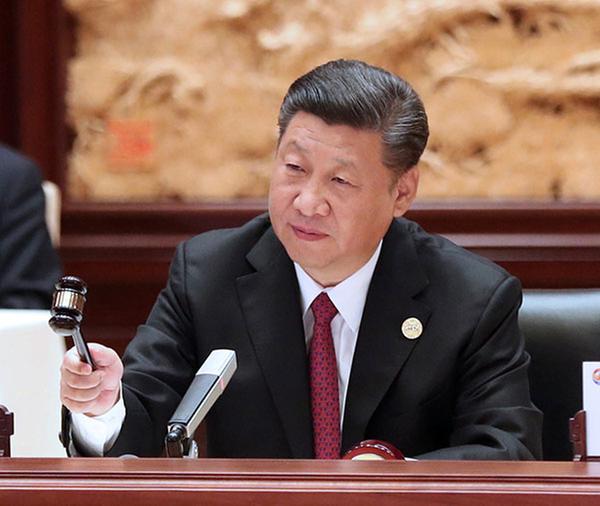 |
| President Xi Jinping announces the start of the roundtable of the Belt and Road Forum on Monday in Beijing.[Photo by Ma Zhancheng/Xinhua] |
It certainly is too early to tell how well the ambitious Belt and Road Initiative will work off the drawing board. For any undertaking of such magnitude, there are always more variables than certainties.
Yet the joint communiqué and list of deliverables the Belt and Road Forum for International Cooperation produced will surely inspire greater optimism about its prospects.
In the communiqué, the leaders of China and 29 other participating countries expressed a shared commitment to cooperation under the framework of the Belt and Road Initiative, expounding its objectives, principles and measures of cooperation. The 76-item checklist encompasses both memorandums of intent to collaborate and agreements on specific connectivity projects.
If the former testifies to a shared political will to pursue common prosperity amid the severe global economic headwinds, the latter showcases how much China as a country has committed to realizing the blueprint, financially in particular.
President Xi Jinping talked about synergy while addressing the Leaders Roundtable on Monday, once again driving home the message that, although China proposed the initiative, it is not China's solo show.
Many of the current misgivings about China's role in the Belt and Road narrative have to do with the perception that the initiative, featuring China as the advocator and architect, and also its main investor thus far, will end up being China's vehicle for projecting its own influence.
Yet, as Xi reiterated, the initiative was conceived as an open platform by all, of all, for all. Although it has made tremendous financial commitments to a number of infrastructure projects under the initiative, Beijing is more preoccupied with kick-starting the process by doing so. Even with the financial resources at its disposal, the Chinese government cannot afford to buy influence on such a scale, even if it wished to.
Since the initiative is not an aid program, of course China will keep an eye on the economic returns. Only economically viable projects can be sustainable, and they should bring lasting benefits to local residents in the host countries.
Also because of the initiative's nature as a joint development program, the partnerships fostered thereby will have to engage deeper, broader participation from the host countries, so as to make the partnerships more equitable.
The just concluded forum was no doubt a success for what has been accomplished. But it will take strenuous, persistent follow-up efforts to translate the long list of agreements and pledges of intent into real world outcomes.
That will involve communicating and coordinating.
- Xi: China to host 2nd Belt and Road forum in 2019
- How the Belt and Road could change the 21st century
- Joint Communique of the leaders roundtable of the Belt and Road Forum for International Cooperation
- List of Deliverables of the Belt and Road Forum for International Cooperation
- 7 ways China will promote the Belt and Road Initiative





