



Diplomacy needed to defuse DPRK issue









 |
| SHI YU/CHINA DAILY |
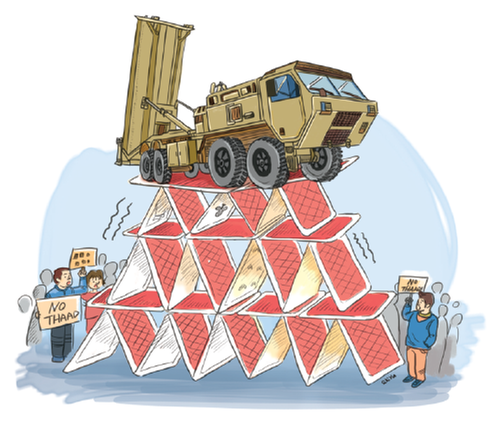
US President Donald Trump's comment that the Republic of Korea should pay for the Terminal High Altitude Area Defense anti-missile system is quite disturbing for many people in the ROK. It looks like he wants to charge them for a very expensive product which they did not even order.
The deployment of THAAD has been a controversial and divisive issue among the people in the ROK. There is still no clear conclusion on the military usefulness of the anti-missile system or its strategic implications. It is shameful that parts of THAAD abruptly began to be placed on the deployment site in Seungju amid heightened tensions last Wednesday.
It has been reported that US Vice-President Mike Pence, on his way to visit the ROK with his foreign policy staff on April 16, said the ROK's next administration (not the incumbent one) should make the decision on THAAD's deployment and operation. A new ROK president will be elected on May 9, replacing the impeached and ousted Park Geun-hye. It is not politically legitimate, therefore, for the outgoing interim government to drive a nail into an issue of utmost importance.
Moon Jae-in, the front-runner in the presidential campaign, has been insisting that the THAAD issue be left for the next government to decide. As such, the haste shown by the interim ROK administration to fix the THAAD issue before a new democratically elected government takes office is totally unwarranted.
The new government can review the deployment of THAAD on ROK soil and, if needed, renegotiate the issue with a full and complete understanding of the strategic ramifications which have been missing in the Park government's decision.
In addition, a great majority of the ROK people will not agree to contribute to the $1 billion bill Trump has demanded for THAAD. Some reports even say there is neither an agreement between the US and ROK governments nor any legal obligation in accordance with the Status of Forces Agreement that Seoul should pay for the weapon.
Trump "submitted" the THAAD bill and raised the issue of reforming the ROK-US Free Trade Agreement together, describing the latter as "horribly" unfair to the US. By raising two thorny issues simultaneously, Trump believes he can strengthen his bargaining strategy to derive the maximum out of the opposite party. However, he must realize that it will make ROK people feel unhappy with the US.
Particularly worrisome is the fact that Trump said a major conflict with the Democratic People's Republic of Korea is possible. The Trump administration has been saying all options, including military, are on the table to resolve the DPRK nuclear issue. It is difficult to tell whether his use of rhetoric was to preempt another nuclear test by the DPRK or whether he really believes in accomplishing a goal by launching a military attack, as he did in Syria.
But every effort must be made to prevent a military conflict, because it will be calamitous and could snowball into a full-scale war.
Trump's threat strategy has not deterred the DPRK from carrying out another missile test, although it failed. Worse, some reports suggest preparations for the sixth nuclear test by Pyongyang have been detected. The Trump administration's coercive diplomacy does not seem to be effective. Rather, it has raised military tensions on the Korean Peninsula to record high levels. Only when the saber-rattling between Washington and Pyongyang stops will the tensions defuse.
The purpose of showing off the US' military might should be to draw the DPRK to the negotiation table. A better means than weapons for pursuing peace and security is diplomacy, because it dares to negotiate with the opposite party tenaciously and with endurance.
Is diplomacy at work between the US and the DPRK, the US and China, and the ROK and the DPRK? It doesn't seem so.
Is an Iran-style nuclear deal between the US and the DPRK possible? We can only hope so.
Continuous provocative activities, on the pretext of national security, only promotes hard-liners in the US and the ROK who argue for military strikes and containment policies as the only effective option.
The author is a professor at the Department of Political Science and Diplomacy of Pusan National University, the Republic of Korea.





