



Supply-side reform reaps healthy return









China has made new progress toward carrying out supply-side structural reform in the first quarter of the year, the National Bureau of Statistics said on Monday. Analysts said a balance should be struck between pushing forward reform and achieving stable economic growth.
Supply-side structural reform-as measures to raise efficiency, including cutting overcapacity, reducing inventories, deleveraging, lowering costs and strengthening weak links-h(huán)ave made much headway in the first three months of this year, said NBS spokesman Mao Shengyong.
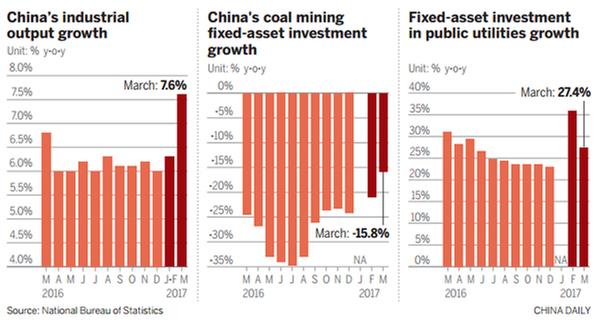
The capacity use rate of major industrial firms, which measures the efficiency of corporate operations, rose 2 percentage points from the fourth quarter of last year to 75.8 percent in the January-March period, while coal output dropped 0.3 percent year-on-year, the NBS said. The amount of unsold commercial housing space fell by 6.4 percent year-on-year, 3.2 percentage points higher than at the end of last year, it added.
The asset-liability ratio of industrial enterprises dropped by 0.6 percentage point year-on-year to 56.2 percent in the first quarter. And the country's fixed-asset investment in ecological system protection, public utilities, agriculture, and water conservancy management increased by 48.1 percent, 27.4 percent, 24.6 percent and 18.3 percent, respectively, in the same period. All were higher than the overall fixed-asset investment growth of 9.2 percent.
"Supply-side structural reform has played a role in boosting the stable growth of the national economy," said Zhang Siping, founder of the Innovation and Development Institute, a Shenzhen-based independent think tank. "The relationship between stable growth and structural reform should be properly handled."
Central and local governments should better coordinate cost reductions when carrying out supply-side structural reform, said Feng Qiaobin, an economics professor at the Chinese Academy of Governance.
For example, in cutting taxes, local governments should have access to stable fiscal revenue sources so that they would not take other reform-offsetting measures to replenish the local coffers after their fiscal revenues decrease.
China's economic structure has also become balanced and new drivers for growth are posting a stronger presence in the first quarter, according to NBS data.
The nation's industrial structure is increasingly dominated by the services sector and consumption, shifting away from the previous reliance on investment.
In the first quarter, the added value of the tertiary sector accounted for 56.5 percent of GDP, 17.8 percentage points higher than that in the secondary industry.
- Qin He: Promotion supply-side reform in the field of education
- NDRC head: China to further deepen supply-side structural reforms
- Chinese premier stresses agricultural supply-side structural reform
- Innovation imperative to supply-side reform
- Strengthen Agricultural Supply-side Reform and Improve the Quality of Green Development in Agriculture and Rural Areas











