



Some still can't see the wood for the trees in Sino-US ties









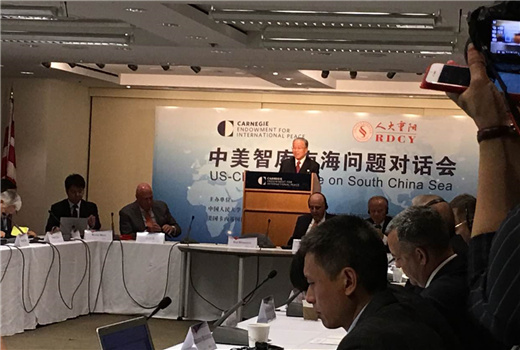 |
| Former State councilor Dai Bingguo delivers a speech at China-US Dialogue on South China Sea between Chinese and US think tanks on July 5 in Washington. Photo by Ji Tao/China Daily |
It's no exaggeration to say China-US relations have in recent times been hijacked by the South China Sea issue, at least in the headlines. Some Chinese and US think tank experts I talked with blamed the media for making the situation worse by portraying a picture very different from reality. Despite being a journalist, I agree with them even though a few think tanks in Washington have also fanned the flames for their ulterior motives. In Washington, many people know exactly which ones I mean.
Indeed, many people fail to see the wood for the trees in the hugely consequential Sino-US relationship. Many aspects of that relationship hardly make headlines, especially in the mainstream US media. It's just like the way they have been covering the 2016 US presidential election.
Last Friday, I attended a breakfast meeting of the US-China Strong Foundation, which re-branded itself just a month ago from the original 100,000 Strong Foundation. After accomplishing its early goal of sending 100,000 US students to China, an initiative taken by US President Barack Obama in 2009 and fully supported by the Chinese government, the foundation is now expanding its mission, which includes the 1 Million Strong-to help increase the number of US K-12 students learning Mandarin to 1 million by 2020 from the present 200,000. This ambitious initiative was also proposed by Obama during President Xi Jinping's state visit to Washington last September.
Travis Tanner, president of the foundation, is actually in Beijing now and will be based at its China office. CEO Carola McGiffert and her small team are all amazing people. I had a chat with Morgan Jones, its chief operation officer, in Shanghai dialect. Hannah Kerne, the associate director of programs and communications, spent three years in China, during which she also taught students in rural Yunnan province.
More exciting is their passion for the cause of investing in a new generation of leaders who have the knowledge and skills to engage with China. Such a generation would not be easily misled by sensational headlines and presidential campaign rhetoric when it comes to China-US relations.
On Friday evening, I attended a reception at the Chinese embassy in Washington to mark the 60th anniversary of Sister Cities International, a Washington-based nonprofit organization that was set up under the citizen diplomacy initiative of former US president Dwight Eisenhower. The 400 participants from dozens of countries were enthusiastic about the sister-city relationship.
President Xi is a prominent member of that group, as Mary Kane, president and CEO of SCI, noted that Xi first visited the US in 1985 as part of an agriculture research group to Muscatine, Iowa, under a sister-city relationship between Iowa and Hebei province.
Xi revisited Iowa in 2012 as vice-president and he went to Lincoln High School in Tacoma, Washington, a sister city of Fuzhou, Southeast China's Fujian province, last September as China's president. Xi worked as Party secretary of Fuzhou in the early 1990s and later as governor of Fujian province.
Chinese cities and provinces have sibling relationships with 258 US cities and states. The China-US relationship at the sub-national level certainly looks healthy and exciting. More US governors and mayors are embarking on regular trips to China, a major trade partner and growing investor form any US cities and states. The 300,000 Chinese students studying in US colleges and universities and the 2.67 million Chinese who visited the US in 2015 thanks to a bilateral visa extension program in late 2014 have injected positive momentum to the relationship.
This is just a one small part of the positive side of the China-US relationship. It is a pity then that many people still can't see the wood for the trees in this relationship.
The author is deputy editor of China Daily USA. chenweihua@chinadailyusa.com





