China growing a green thumb for finance









With major environmental projects in pipeline, Beijing is set to affirm its leadership
International leaders in the green finance field have endorsed China's emphasis on developing the sector in its 13th Five-Year Plan (2016-20), and say that China's leadership in the creation of standards will nudge global volume.
Green finance is a relatively new concept that aims to channel institutional investment into projects that address environmental concerns. Globally, about $40 billion in green bonds have been issued, but experts say China needs at least 2 trillion yuan ($312 billion; 287 billion euros) to achieve its environmental targets under the plan, meaning China could become even more of a leader in green finance.
Seen as the blueprint for China's development for the next half-decade, the new five-year plan will be published next year. A proposed plan was adopted at a key party meeting in Beijing on Oct 29. The proposal says China will develop green financing systems and create green development funds.
Nick Mabey, chief executive and a founder of Third Generation Environmentalism, a nonprofit company, says China's emphasis on green finance has significance beyond purely environmental protection measures.
"On the one hand, China's focus on green finance effectively channels funds into environmentally friendly projects, but on the other hand the introduction of transparency and corporate governance required for projects to attract green finance funding is also a catalyst for China's financial reform," Mabey says.
Green finance projects include various asset classes, such as green bonds, green initial public offerings and green investment banks.
Green bonds, for example, have proceeds invested in environmentally friendly projects. They are popular with institutional funds that advertise green credentials to attract clients. These funds may have more transparency than conventional bonds, since the use of proceeds often is certified by a third party to ensure the use is solely for environmental projects.
Within this context, the transparency, certification and corporate governance practices needed by projects in China to attract green finance funding would set a good standard for the country's overall financial reform, as increasingly more infrastructure projects use such standards, Mabey says.
Klas Eklund, a senior economist at Swedish bank SEB, says China's emphasis on green finance in its 13th Five-Year Plan demonstrates that the country has chosen the right instrument to combat climate change and encourage sustainable growth.
"The previous growth strategy was built on cheap credit on a massive scale. The new normal and ecological society must mean economizing both with credit and natural resources. Hence, green finance is central to the transformation," he says.
There are many potential policies China could consider including in its plan for the next five years, Eklund says. His suggestions include establishing a green development bank, building a green capital market with green bonds, launching a national green development fund and implementing compulsory environmental liability insurance.
A green development bank is a public bank that encourages private funding in green projects by taking on the initial project risks itself, and also conducts research into projects' risk return profiles to aid private evaluation.
"Underlying all of this is the need to set up a comprehensive legal foundation of the new system, and to educate a new generation of bank managers, analysts, accountants and environmental experts in the financial sector," Eklund says.
Sean Kidney, CEO and cofounder of the Climate Bond Initiative, says China has a lot of experience in green finance to share with other countries, especially emerging economies in similar stages of development. "Climate finance initiatives greatly depend on infrastructure building, financing and regulation, which China has extensive experience in.
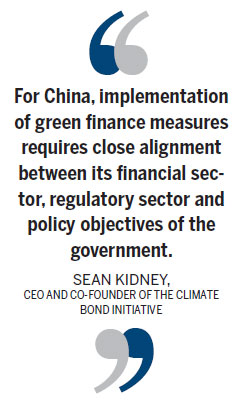
"For China, implementation of green finance measures requires close alignment between its financial sector, regulatory sector and policy objectives of the government. For example, the activities of the People's Bank of China will be coherent with the policy objectives of the 13th Five-Year Plan. This is a model that would work well in many other emerging economies," Kidney says.
China-led multinational institutions such as the Asian Infrastructure Development Bank and New Development Bank (formerly BRICS Bank) can play a key role in spreading China's experience in green finance to other emerging countries, he says.
"These institutions will promote investment in infrastructure projects of emerging economies, green investment, and will help to propose best solutions for infrastructure projects for the long term in emerging economies," Kidney says.
cecily.liu@chinadaily.com.cn
(China Daily European Weekly 12/11/2015 page20)






Today's Top News
- PLA Daily: China resolute in winning anti-graft war
- Davos meet lays bare tensions and challenges
- Growth gaining traction amid upbeat outlook
- Bowl of laba serves as prelude to harmonious new beginnings
- Visit highlights cooperative nature of China-Europe ties: Editorial
- Placating bully with concessions 'fool's errand': China Daily editorial