



US' candidates have nothing to offer have-nots









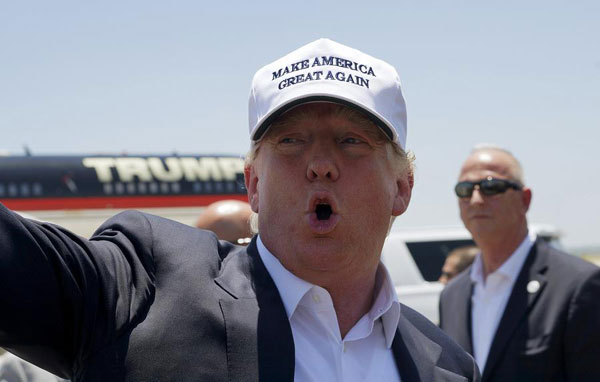 |
| Republican presidential candidate Donald Trump talks to reporters as he arrives in Laredo, Texas July 23, 2015.[Photo/Agencies] |
Of all the Republican and Democrat candidates in the 2016 US presidential race, almost each and every of them claims that he or she will fight for Main Street not Wall Street, despite the fact that big businesses often finance most of the campaigns.
A Gallup poll released last week may well explain why these candidates, in a bid to win votes, are so eager to pledge that they will be the true savior of less-advantaged Americans.
The survey finds that only 58 percent of Americans see themselves as "haves" while 38 percent regard themselves as "have-nots". The percentage of have-nots has more than doubled since 1988, but has been more stable in recent years.
And 45 percent of the people in the survey say they think the US society has been divided into groups of haves and have-nots, compared with only 26 percent in 1988.
These findings came after a May survey which showed that 63 percent of Americans say money and wealth distribution is unfair in the United States.
It is not hard for someone living in Washington to see the have-nots. Just around my office in the National Press Building or the DuPont Circle on my way home or under an overpass passing the Rock Creek Park, homeless people are a daily scene, even amid the snows of winter.
On any given night, there are 7,784 homeless people in the District of Columbia, according to the Community Partnership for the Prevention of Homelessness.
African-Americans are among the most underprivileged groups, as revealed by both the survey and their frustrations vented during the recent protests in many US cities.
While class struggle was a catchphrase in China during the "cultural revolution" (1966-76) and income inequality is also challenging China today, there is no doubt that there is also a very real class struggle in the US today, despite the fact that US officials and mainstream news media never use such a politically incorrect term.





