



Hobson's choice for China on procurement









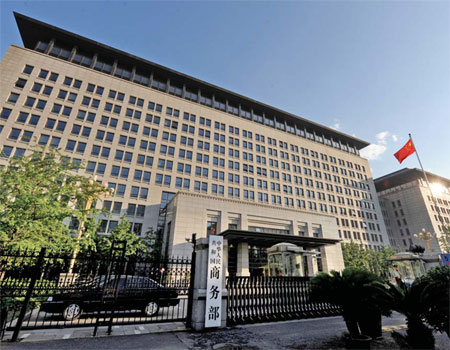
| An official from the Ministry of Commerce says there is little chance that China will join the World Trade Organization's government procurement agreement this year. Hu Qingming / for China Daily |
Exporters stand to reap lucrative rewards if nation joins accord, but eu moves create more hurdles
Chinese exporters are likely to encounter more hurdles if the nation continues to stay away from the World Trade Organization's government procurement agreement this year, experts say.
Suo Bicheng, director of the Department of World Trade Organization with the Ministry of Finance, says higher standards set by developed nations are delaying China's entry. At the same time China also needs to tweak its domestic regulations before signing the agreement, he says. The WTO agreement aims to allow foreign companies to participate in government purchase deals.
"A lot of problems need to be resolved before China can join the pact. There is little chance of any success in the short term, or even this year," says Suo.
Despite the expected delay, experts feel that China should speed up the process.
"There are many who feel that domestic companies may face stiff competition from foreign players if China joins the procurement agreement. But we cannot risk big things for the sake for small matters," says Li Jian, a researcher with the International Trade and Economic Cooperative Research Institute, a think tank under the Ministry of Commerce.
"As an export-oriented country, what will happen to China if other countries decide to keep Chinese companies out of their government procurement lists," he says. "China can reinforce its determination to maintain multilateral trade relationships if it joins the agreement."
The European Union is likely to introduce a modified version of its government procurement agreement this week.
According to reports, the new version seeks to bar companies from certain countries, including China, from taking part in the EU's agreement so that more European companies can participate in the procurement process.
"Developed countries, especially the EU and the US, have been urging China to open its government procurement market to foreign companies, because they all know how big the market is," Li says.
The European Chamber of Commerce in China estimates that the Chinese government's procurement budget entails the spending of nearly $1 trillion (755 billion euros).
"Looking at the big picture, I feel that China will tend to gain more as it already permits foreign companies in some of the government procurement programs, whereas its overseas participation is still limited," says Liu Ligang, head of the Greater China Economics Department at ANZ Research. At the same time, Chinese companies are now better equipped to compete for foreign projects, adds Liu.
According to reports, the government procurement budget usually accounts for 10 percent to 15 percent of the country's GDP, while 10 percent of the budget goes to foreign products and services.
"The US budget can reach $2 trillion, and the EU's $2.8 trillion. Even if Chinese exporters can get only 5 percent of the procurement pie, the returns will be more than commensurate. As long as some portion of it, say 5 percent, goes to Chinese exporters, it will be more than enough to maintain steady export growth," Li says.
With demand from overseas markets continuing to wane, Li says domestic demand alone cannot make up for the export losses so China should seek new opportunities.
"Joining the agreement can help Chinese companies overcome many of the legal hurdles they face in foreign markets," he says.
Opening up the government procurement agreement is one of the commitments China made when it joined the WTO in 2001. But developed countries have for long been accusing China of not making enough efforts in this regard.
The most recent protest from developed countries was over China's new restrictions on automobile purchases for the government
On March 5, the European Chamber of Commerce in China said that while it welcomed the Ministry of Finance's plan to de-link government procurement from indigenous innovation, effective July 1, 2011, it remains disappointed that the preliminary list for purchasing automobiles under the government procurement scheme issued by the Ministry of Industry and Information Technology runs contrary to such commitments.
The ministry list excludes foreign brands in this year's government procurements scheme for automobiles.
The chamber has urged the Chinese government to revise the preliminary list and include all cars that meet the identified cost and engine size requirements.
"We oppose protectionist measures in government and public procurement, and want China to allow the same kind of access to its markets that Chinese companies enjoy in the EU," the chamber said in a statement.
However, experts say the EU has overreacted on the issue.
"It is natural for China to protect its local industries, especially those that have limited competitiveness in the global market. Actually, the EU and the US are making more efforts in protecting their own manufacturers. In other fields, their restrictions are even stricter," says Yao Jinjian, a professor at the University of International Business and Economics.
Yao believes that if China is part of the WTO government procurement agreement, such situations can be avoided.
"Apart from the competition, it is also a motivation for Chinese industries and companies to survive and develop better in the long term," he says.
The Chinese government has already gauged the costs and benefits of the scheme and has in several previous instances come close to joining the agreement.
The first attempt by China to become part of the procurement agreement came in 2007, but failed, as it did not pass muster with some of the other members. In July 2010, China submitted a second offer. Various developed countries and regions, led by the US and the EU, praised the country's revamped proposal, but said China could not join the agreement unless it made further concessions from its side.
The latest attempt was made in November, but it was stymied again as it did not meet the current participants' expectations.
"Developed nations always keep changing the standards in such a manner that it acts as a barrier for the entry of others," says Suo from the Ministry of Finance.
Contact the writers at yanyiqi@chinadaily.com.cn and dingqingfen@chinadaily.com.cn


Today's Top News
- Flood of opportunities in ecological preservation
- China urges US to honor its commitments
- Two former defense ministers get suspended death verdict
- Understandings 'reached' to ease naval blockade
- Stable Sino-US ties linked to global growth
- China, US urged to work for more practical results





