



Dictionary of the people









《新華字典》定義的不僅是 "字" , 還有大眾知識(shí).
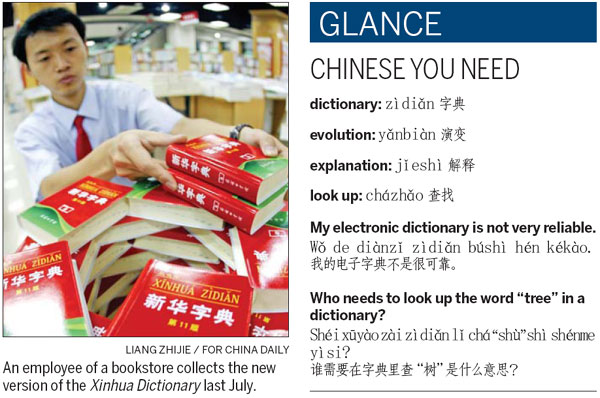
'Islew the wrong goose," a man complained in his letter to the editors of the Xinhua Dictionary.
It was the 1970s, and the man needed to slaughter a male goose from the flock he had raised. Unable to distinguish the male geese from the females, he consulted the Xinhua Dictionary.
"Goose: A kind of poultry," it read. "The male goose has a yellow bump on its head."
Satisfied, he trundled off, plucked out a goose matching the description and brought it home for slaughter. Slicing open its stomach, he immediately cursed the dictionary - as the valuable eggs needed to sustain his flock poured out onto the counter.
While the dictionary entry was not entirely wrong, it had not made clear that all geese have a yellow bump on their heads; those of the males are just larger. Sympathizing with the man's complaint, the editors corrected the error in the next edition.
For better or worse, the Xinhua Dictionary has been used as an encyclopedia by people across the Chinese mainland since its inception in 1953. Including the most recent 11th edition, the ever-evolving reference work has sold 400 million copies, a track record bested only by the Bible and a handful of other religious, political and a few literary texts.
So what is a dictionary doing in the upper echelons of China's all-time best-sellers list?
Like most of the other top-selling texts, the dictionary propagated a world view. When it was first published, the name Xinhua - literally "New China" - bore the hope of a country reborn.
Linguists meticulously wrote and edited the content, which was the first to be compiled in Modern Chinese. In a way, they were defining not just words, but the future character of public knowledge and ways of thinking.
"My family got their first dictionary in the 1960s," recalls Qing Zhu, who grew up in the countryside of Jiangsu province. "Before that, we turned to the shizi xiansheng (識(shí)字先生, 'literate man') in our village whenever we needed to write anything."
The dearth of knowledge was such that, in some regions, early editions of the dictionary featured illustrations for entries like "pigeon", "brain" and "umbrella", and there was even a manual detailing how various chemical fertilizers should be used.
The scholars behind that first edition were certainly patriotic, if not particularly political-minded. That all changed with the "cultural revolution" (1966-76). Copies of the previous year's edition were stripped of their covers and sold cheap, with many carrying a sticker on the first page cautioning readers to adopt a critical approach when consulting them.
In 1970, when schools re-opened after a three-year closure, the need for a new, more politically correct edition became even more pressing. The 1971 dictionary was originally supposed to include changes to more than 1,000 entries. Fortunately, Premier Zhou Enlai stepped in to directly supervise production, ensuring that in the end only 64 changes were made and the dictionary's dignity was preserved.
Forty-six of Mao's proclamations were inserted into the final version, with two prominently displayed on the title page. There were also clarifications made to existing entries, which in some cases meant appending explicit Maoist instructions.
For example, a sentence used to illustrate the meaning of 等不及 (dengbuji, cannot wait to) was previously "I cannot wait to go back home," but this was changed to "I cannot wait to return to my work station."
It was hard to erase all traces of that era's misconceptions in one fell swoop, but Su Peicheng, one of the editors of the 1971 edition, announced to the national press that he and his team "were no longer making political dictionaries".
As the dictionary became increasingly depoliticized, prostitutes were no longer described as "the outcome of an exploiting institution", and gambling dropped its tag as "a vice prominent in pre-liberation China."
Meanwhile, other changes signaled unrelated shifts in cultural mindset. While "sturgeon" was once defined as "edible," later editions provided the slightly more eco-friendly description of "an endangered species."
By the same token, leopards shed their categorization as "wild animals whose fur can be made into clothes." However, tigers were not so lucky, with "tiger hunting" remaining the illustration for "to hunt" up until the 10th edition.
The dawn of the economic reform and opening-up era heralded a revival for educational resources, and the subsequent influx of thousands of dictionaries has eroded the Xinhua's stranglehold on the market.
The policy also spurred the production of a slew of reference books dealing with specific subject matter, ranging from tea to various fields of academia, all of which further whittled down the Xinhua's status as the go-to publication for both researchers and the public.
Still, even today the Xinhua Dictionary remains the standard reference for students learning characters, and the one book that first graders are told to buy before they start school. Every year, primary schools all over the country host intensely competitive word-search competitions, which challenge kids to look up the definitions of random words in the fastest possible time.
One curious result of this childhood love affair with the Xinhua text is a marked similarity in the way Chinese children speak and, to a certain extent, think.
"All (China's) primary school compositions are similar and standardized," a 2010 editorial in Guangzhou's Southern Weekly newspaper claimed. "For example, if (Chinese children) write about a spring expedition, the sky is invariably 'cloudless for ten thousand miles' and we will undoubtedly 'sing and dance' on our way," both expressions sourced from the dictionary.
Last year saw the publication of the illustrious tome's 11th edition and, with it, the standardization of a raft of new words and explanations. The text that once featured illustrations of an umbrella now uses mobile phones to illustrate the meaning of "handy, portable" (手 shou).
But in a tacit acknowledgement of the proliferation of alternative sources of information, the editors have scrapped a whole host of definitions under the proviso that people do not need a dictionary to help understand them. Entries like "kerosene", "motor" and "secretary" have been consigned to the scrapheap.
For such a traditionally conservative publication, the 11th edition also sparked controversy for its inclusion of words recently made popular by tabloid news titles, online forums and personal blogs.
"Gate" (門 men) is interpreted as a "scandalous event" based on the infamous 2008 sex photo scandal involving Hong Kong actor Edison Chen.
The influence of English on Chinese was also acknowledged, with 曬 (shai, to dry something under the sun) listed as having the second meaning "to share" due to the similarity in pronunciation with the English word.
Recent cultural phenomena have also been addressed via the inclusion of entries like "house slave" (房奴 fang nu), a metaphor for people forced to slave away at their jobs in order to afford loans for an apartment.
Until the latest edition, the only explanation of "slave" had been: "People who had no freedom and were oppressed, exploited, and used as labor by the exploiting class in the pre-Liberation China."
Courtesy of The World of Chinese, www.theworldofchinese.com


Today's Top News
- Flood of opportunities in ecological preservation
- China urges US to honor its commitments
- Two former defense ministers get suspended death verdict
- Understandings 'reached' to ease naval blockade
- Stable Sino-US ties linked to global growth
- China, US urged to work for more practical results





