



A proactive approach to luck









|
|
Superstitions live on in China because, as many doubters say, better safe than sorry
Imagine leaving a 12-year-old at home an entire day with doors and windows tightly closed, only to open them exactly at midnight with the child struggling to stay awake.
Mao Weiwei, now 26, spent just such a day in the summer of 1997, supposedly for her own good. She needed to avoid the evil spirits and bad luck that were predicted to befall her on that particular day in the Year of the Ox.
"I dressed in pajamas, watching TV and eating a lot that day. The superstitious precautions followed word-by-word the advice of a fortuneteller my aunt had visited."
Mao's parents were indifferent to fortunetelling but wanted to be on the safe side for their only child. That makes them fairly typical in China. But her aunt, now 57, has always gone to great lengths to pursue good luck and dodge ill fortune.
She invited Buddhist monks in Tibet to pray for Mao when she sat for college and graduate school entrance exams in 2004 and 2008.
|
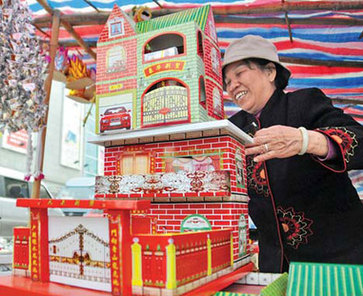
A vendor tidies a paper replica of a villa at a market in Nanning, capital city of South China's Guangxi Zhuang autonomous region. Many Chinese buy and burn these and similar replicas of goods and money as offerings to deceased family members. [Lu Bo'an / for China Daily] |
"It cost about 2,000 yuan ($320) each time for the service. My aunt would like to think my success in both exams was thanks to her efforts to ask for Buddha's blessings on my behalf. I know it is due to my own hard work," Mao said.
She teaches at an English training center in Beijing.
Once Mao lost a Buddha pendant, a gift from the aunt, when she was at university in Shanghai. Mao was nervous and immediately called her mother. The aunt quickly learned the news and was pleased with Mao's reaction. A few days later, the aunt bought Mao a jade Buddha pendant.
Mysteriously, Mao found the old pendant under a pile of clothes when she received the new one. Now she leaves them in her eyeglasses case at home in Shenyang, Liaoning province, so they won't get lost again.
"I generally do not follow superstitions. But in this case I think Buddha saw my earnest regrets for not taking good care of the pendant and forgave my negligence," she said.
The fortunetellers
The aunt, Mao Chongjun, changed her name in 2000 at the age of 46 because she thought the earlier name, Mao Jun, had brought her rough years and difficulties.
She twice changed the name of her only child - from Chen Mao to Chen Yundi and finally, when he was 10, to Chen Guoquan - because he suffered poor health and frequent high fevers.
Chen studied cartoon animation at a university in Dalian, Liaoning province. When he graduated in 2010, he wanted to open a restaurant. The aunt consulted a fortuneteller and anxiously talked Chen out of the idea because it could lead to calamities. Chen dropped the idea and remains unemployed.
The aunt checks the match of Chinese horoscope signs when Chen introduces a girlfriend. She also has told Mao of a fortuneteller's version of Mao's future Mr. Right.
"He will be in the diplomatic field. His work has much to do with English. And I will get married before 30." Mao repeated the predictions, and rolled her eyes.
Mao's maternal grandmother died in 2011. She was attracted to Buddhism in her last years, suffering from illness, because she wanted to pray for a longer life.
The grandmother had lost a son in his prime. Fortunetellers had warned that he should not seek to have any girlfriend or it would mean very bad luck because he was the virgin boy disciple accompanying the Bodhisattva Avalokitesvara (Guanyin in Chinese). In other words, should remain single.
He later had an accident on a motorcycle ride with his girlfriend and underwent a blood transfusion. The blood he received was tainted, and he developed uremia.
Medical treatments were limited at that time, so the family relied heavily on superstitious practices, such as summoning his spirit, to remove his pain. By following these steps, his relatives felt they had done what they could to save his life, and came to terms with his leaving.
"After he passed away, my grandparents had a dream, seeing him resume his position beside Guanyin and smile at them," Mao said.


Today's Top News
- Ecology and economics are allies, not rivals
- Lai's stowaway trip slammed as a scandal, farce
- US fires on Iranian tanker while Trump pushes for peace deal
- Nation seeking to attract more intl students
- RMB's role as international option grows
- China ready to help restore peace, stability in Mideast





