60 People, 60 Stories
By design
By Gan Tian (China Daily)
Updated: 2009-09-30 10:07
|
 |
| ||||

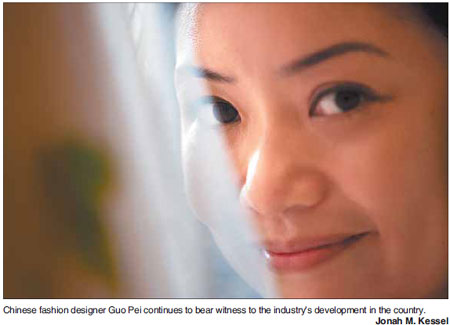
Surrounded by the crowd, Guo Pei kneels down, inspects a pair of red, open-toe shoes and instructs her assistant to accommodate another customer for the next day.
Guo is the top high-end fashion designer in China and she is preparing her new collection for China Fashion Week in November.
"You will see giant evening dresses in my show during fashion week," Guo says, pointing to a half-finished dress on a model in her Rose Studio at the capital's North Fifth Ring Road.
She fell in love with dresses when she was 15, when few people here knew what fashion design was.
"When I majored in fashion design in 1982, no one knew what it was for. My neighbors would ask me, 'What is fashion design?'" Guo says.
She is proud to be a pioneer of the industry. China has a fashion history of 30 years and Guo says she witnessed its beginning.
She remembers clearly the first costume she made - a wedding gown that formed part of her graduation work.
"It was in 1986 and I had no idea where to learn how to design a wedding dress. My tutor didn't know either, so he asked me to finish it on my own."
The sharp young designer headed to the theaters, where many Western palace costumes were designed. She learned a few skills, including using wooden tools to put together dresses. Guo realized there was much to learn in the industry.
Her first show was in 1996, a full decade after she graduated. There were three collections - casual attire, artistic dresses and haute couture. Rave reviews followed, people started to notice and she has not looked back since.
Guo now has about 300 regular clients who are willing to pay up to 1 million yuan a year for her clothes.
Her fame also brought Guo closer to last year's Beijing Olympics.
"I still feel a connection with the Games," Guo says.
As early as 2001, when the world found out China would host the 2008 Summer Games, Guo felt the excitement when she saw female members of the China Olympic bidding team, including celebrity host Yang Lan, wearing her dresses.
"They put on my dresses and exuded confidence and power," she says.
"It spoke of a typical Chinese beauty and that was when I knew the world was looking at us."
Later, when actress Zhang Ziyi appeared at the ceremony in Athens to accept the torch for the following Olympic Games in Beijing, one of Guo's friends told her Zhang looked gorgeous in her dress.
"When I heard the country was asking for fashion designers to submit their costume options for the medal ceremony presenters, I felt it was my job to do so," Guo says.
"I had the draft designs in mind only five minutes after I heard the news - but I knew my designs had to present the elegance and confidence of Chinese women," she says.
Guo blended the Chinese qipao and Western evening gown, complemented with porcelain colors, flowers, dragons and phoenix embroidery.
"Though I spent only five minutes on the draft design, I spent half a year finishing them. It was tiring but it was a special honor."
Guo never thought of giving up in the face of well-known hardships and difficulties in a cutthroat industry. She chose fashion simply because she loves it.
"I was one of those lucky people who could make their interests their career and reap benefits at the same time," Guo says.
For Guo, fashion is all about beauty. And people love to be beautiful.
"Chinese people began to notice what they wear after the country's reform and opening up," Guo says.
If she had to pick one industry to show the differences China experienced in the last decade, it would be fashion.
"The last decade has seen the greatest change and fastest growth in the industry. More fashion magazines appeared, Chinese consumers knew more international brands and more Chinese faces were seen on the global fashion arena."
Time line
1920s-1930s
Western suits and cheongsams become the definitive dress for the urban rich.
1949
While no concrete guidelines are set, existing Western fashion styles of the upper middle class are seen as residuals of a corrupt, exploitative past.
1950s
Amid wars, blockade and construction, the Sun Yat-sen, Lenin and Mao suits become staple wear across China.
Early 1960s
Three years of famine lead to a significant drop in the production of cotton. Wear-resistant gray, dark and blue-colored clothes become standard.
1966-1978
Green army uniforms gain popularity.
1978
Chinese consumers are introduced to Italian brand Versace, the first foreign fashion label to appear in the country.
1979
Pierre Cardin holds the first fashion show in China. Some considered the catwalk as "evil" and "belonging to the capitalist class".
1983
Chinese people begin to wear Western suits regularly after Party chief Hu Yaobang makes consecutive public appearances in Western instead of Sun Yat-sen, Lenin or Mao suits.
1986
Female gym competitors create a nationwide stir by sporting bikinis on stage.
1992
Louis Vuitton opens its shop in Beijing. Armani, Chanel, Gucci and Christian Dior also make their mark in the country.
1999
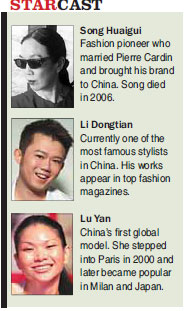
Lu Yan, the first Chinese female model to go global, stirs debate in China for being "too ugly to be a model".
2005
Du Juan becomes the cover girl of Time's supplement. She is the first Chinese supermodel.