60 People, 60 Stories
New challenges
By Zhou Yan (China Daily)
Updated: 2009-09-30 07:41
|
||||

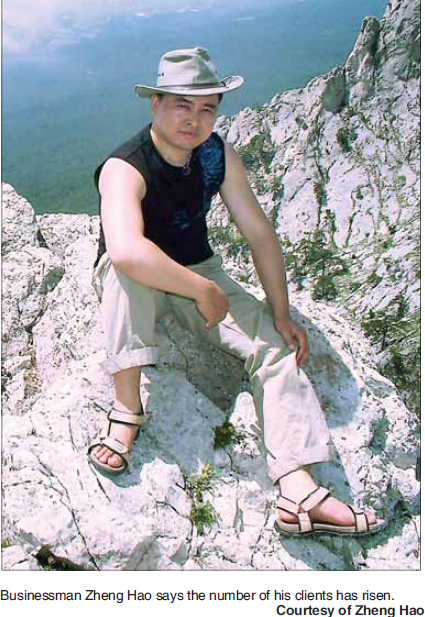
"After seeing a flood of European firms rushing to the country for made-in-China products that year in Shanghai, I reckoned China's export boom was probably set to start," says the 37-year-old Zheng, who took the plunge in December 2003 to establish his own firm, Tuolima, specializing in exporting equipment for fiber optic networks.
China's export boom was largely based on China's entry to the World Trade Organization (WTO) in 2001, a move that accelerated the nation's economic restructuring and triggered rapid foreign trade growth given Chinese products' competitiveness in the international market.
"Most firms in Europe traded products within the region when I went to Ukraine in 1995," Zheng recalls, adding that then, China mainly sold textile goods to Eastern Europe.
Customs figures showed that the average growth of China's foreign trade between 1978 and 2001 was 15.9 percent, with textiles the top export category.
With an average increase of more than 20 percent from 2002 to 2008, China notched up $2.56 trillion in foreign trade last year and is now the second-largest exporter after Germany.
However, the rush to export products overseas also generated quality concerns that fueled international concerns involving products from toys to food.
"It's not surprising the government has focused on the development of high-technology industries like the mechanical and electrical (M&E) sector."
The central government, as early as 1999, launched a strategy to invigorate trade through science and technology, which directly spurred the rapid export growth of products with cutting-edge technologies.
The export volume of M&E products, for instance, hit $822.93 billion in 2008 to become one of the top export industries, compared with 1978's $659 million.
Riding on the thriving trade, in particular in M&E, Zheng's startups saw double-digit sales growth ever since establishment until the global economic upheaval hit in late 2008.
Just before the financial crisis, Tuolima had more than 50 staff, compared to only one in 2003.
But Zheng says that like for most Chinese exporters, developing regions such as eastern Europe were still their products' major destinations given the higher entry barriers in western Europe and North America.
One of Zheng's suppliers, a maker of welding machines, said it is hard to match Japanese peers in high-end markets because of China's immature industry chain and the absence of cutting-edge technologies.
"Things have been changing these years; we've tapped into western Europe and America, but their revenue contribution to Tuolima's total is still very small," Zheng says.
Before the reform and opening-up policy was adopted in 1978, China's 40-plus trade partners were mainly concentrated in the then Soviet Union and eastern European countries.
But the number of trade partners had expanded to more than 220 by 2008, when the country's trade volume with the United States andthe European Union topped $300 billion.
Even though China's foreign trade has faced unprecedented difficulties since last November, posting negative export growth for 10 consecutive months, Zheng is still confident, saying that "recession is good news. At least I saw the number of our new clients rise".
Despite a 70 percent decline in sales volume, Zheng's firm also saw a 30 percent growth in clients' amount from last year.
"We're planning to tie up with some promising manufacturers and explore the Chinese market for sustainable growth, as the space for a pure exportfirm is tending to become smaller," Zheng says.
Time line
1949-1978
Decades of Western blockade following the establishment of the PRC limits China's exports to mostly agricultural produce to Third World countries and countries of the Soviet bloc.
1987
China's foreign trade sector witnesses a loosening from the previous planned management system, with foreign trade ports launched and exports encouraged.
1988-1990
A number of national special foreign trade corporations are launched and the nation starts to place macro controls on foreign trade through pricing, tax rebate and export credit systems.
1991-2001
The foreign trade reform further deepens, with subsidies being scrapped and exporting companies being asked to be solely responsible for their profits and losses.
2001
China enters the World Trade Organization to become its 143rd member. All foreign trade companies enjoy public and transparent competition with a relaxed foreign trade market condition.
2009
By August, the number of foreign trade enterprises in the country hits 755,000. Foreign-invested companies and private exporters combine to account for 76 percent of the nation's overall trade volume. Private exporters are increasingly becoming the mainstream of China's foreign trade. China is currently the world's second-largest exporter, second only to Germany.