News
Fair charts trade history
By Diao Ying (China Daily)
Updated: 2008-09-23 11:30
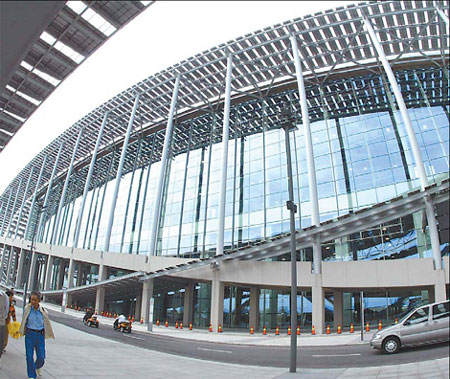
The biannual China Import and Export Fair has long been an event no trader can afford to ignore.
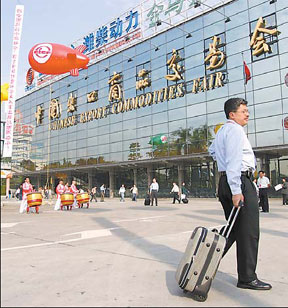
The Canton Fair, as it's known, has been held every spring and autumn since 1957 in the southern city of Guangzhou.
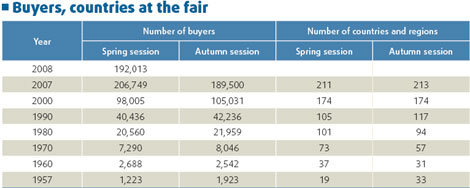
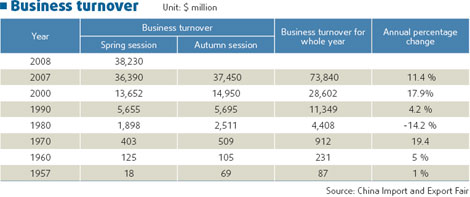
It has become the bellwether of the nation's foreign trade climate. Orders placed at the two-week events usually amount to a quarter of the country's total annual export. Last April, for instance, over 192,000 buyers attended the fair's 103rd session. They made total purchases of more than $38.2 billion.
Huang, a trader who attended the fair in its early days, recalls feeling "honored" to be part of it. She remembers attendants were on hand to help exhibitors style their hair, iron clothes, and even clip fingernails.
In the early days, over 80 percent of China's foreign trade deals were done with socialist countries led by the Soviet Union. But in the 1950s, Guangzhou was already the venue for entrepreneurs from Hong Kong, Macao and Southeast Asian countries looking to do business with the mainland.
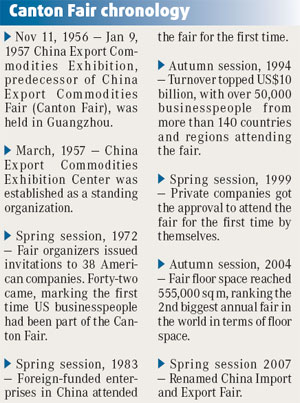
Guangzhou is well positioned for local exporters wanting to trade with the outside world, as it neighbors Hong Kong, from where goods can be transported to other parts of the world. That's why the State Council, short of foreign exchange income at the time, made the city host of the first trade fair.
The first session brought 1,223 businesspeople from 19 countries. They made $18 million worth of deals. More than half of the goods sold at the fair were food products, textiles and crafts. Over 80 percent of the goods were sold to Hong Kong and Macao, while Asian countries bought the rest.
The fair has seen massive change over the past five decades, mirroring China's emergence from a peripheral player in global trade to one of the largest exporters. More buyers from the US and Europe began attending the fair in the late 1970s and 1980s at the beginning of the economic reform. In recent years, a more diversified export market has brought traders from Africa, India and the Middle East.
The fair has also mirrored a significant change in the nation's trade environment, when it set up import booths for the first time at the 100th session in 2006.
The event's name changed to the China Import and Export Fair, as the once cash-strapped country tried to reduce its whopping trade surplus by buying more from other countries.