|
|
 |
|
30th Anniversary Celebrations
New Rural Reform Efforts
Political System Reform
Changing Lifestyle
In Foreigners' Eyes
Commentary
Enterprise Stories
Newsmakers
Photo Gallery
Video and Audio
Wang Wenlan Gallery
Slideshow
Key Meetings
Key Reform Theories
Development Blueprint
Chen Weihua:
Heating the north in a wasteful way  Ashis Chakrabarti:
It's good to go back to basics  Raymond Zhou:
Studying the 'Wen effect'   Zhao Huanxin:
Sweetness and light nourish office worker bees  Fighting the cabbage wars
By YOU NUO (China Daily)
Updated: 2008-12-01 07:47
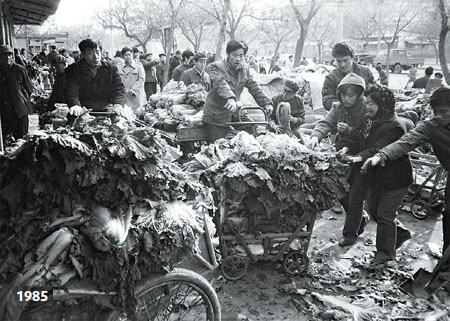
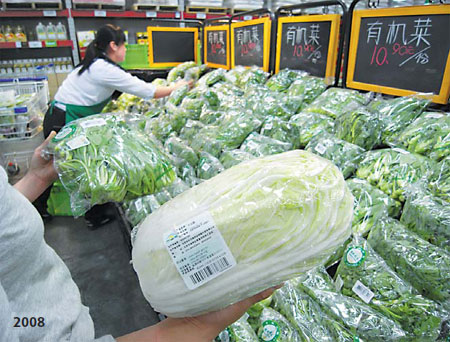 Today's urban consumers may be so used to choosing their favorite items from the supermarket shelves (as in this color photo shot in a Beijing Wal-Mart outlet) that they've forgotten how their parents used to buy vegetables. Up to this day, shopping for groceries is still called "buying vegetables," or "mai cai" in Chinese, a phrase which originally has a much narrower definition. It may partly be because unlike meat, vegetables used to be the staple in all household meals. But it may also be because, despite the large variety of vegetables on the Chinese menu, many of them used to be hard to come by. In fact, some 20 years ago, for the entire population of northern China, all the way from small towns in the western Gobi desert to major cities as Beijing and Harbin, housewives had only one green vegetable to rely on for the whole winter. It was the light green Chinese cabbage, or "bai cai" in Chinese. Of course, there were other items such as potatoes and onions. They were also cheap and could be stored in large quantities. But they were not green. Nor were they as versatile as the cabbage, serving as dumpling stuffing as well as being stir-fried. Between November and December was the time for every household to store their winter cabbage supplies. Residents used to be informed by their nearby State-owned grocery shop, by written notice and by word of the mouth, about the arrival of the cabbage shipment. On delivery day, truckloads of cabbages were piled up along the street. All families rushed to the street-side ad-hoc distribution centers, pulling whatever transport tools they could get, from tricycles to old style bamboo baby carriages. For a few days, it was if every city had fallen into a people's war of cabbage. The practice went on year in, year out. Even though many northern Chinese kids were so bored by continuous cabbage dishes in the winter, parents would still place their new orders as every winter approached They also knew that the price would be kept very low (usually below 0.1 yuan per kilogram), thanks to the government subsidy. Yet that was the limit of the planned economy - a general equality based on a low living standard of only several low-priced major supplies. What is shown in our 1985 black-and-white photo is actually a much milder cabbage war, with far fewer people than in the early 1980s. In fact, between the mid-1980s and 1990s, households in northern Chinese cities bid farewell to the age-old practice of storing cabbages on stairways, balconies and outside windowsills. The growing market economy is now able to provide even the cities in the coldest and most arid areas with vegetables of all kinds. At the same time, not surprisingly, the 0.1-yuan-per-kilo cabbages and the street-side piles disappeared, replaced by carefully wrapped ones on supermarket shelves. Now the challenge facing the government is no longer how to feed 1.3 billion people, but how to ensure the quality of the food they get.
 (China Daily 12/01/2008 page1) 
|
       |
南木林县| 固安县| 呼玛县| 美姑县| 宜良县| 甘泉县| 潞西市| 黔江区| 章丘市| 丹阳市| 额尔古纳市| 礼泉县| 筠连县| 兖州市| 凌海市| 观塘区| 万盛区| 长丰县| 房产| 施甸县| 随州市| 通榆县| 耿马| 眉山市| 抚顺市| 淳化县| 新干县| 宣武区| 治县。| 邹平县| 五原县| 望谟县| 通河县| 泰州市| 沾益县| 朝阳县| 廉江市| 昌平区| 肥东县| 平武县| 外汇|