|
|
 |
|
30th Anniversary Celebrations
Economic Development
New Rural Reform Efforts
Political System Reform
Changing Lifestyle
In Foreigners' Eyes
Commentary
Enterprise Stories
Newsmakers
Photo Gallery
Video and Audio
Wang Wenlan Gallery
Slideshow
Key Meetings
Key Reform Theories
Development Blueprint
Li Xing:
Teachers like Li need our support  Alexis Hooi:
Going green in tough times   Hong Liang:
Bold plan best option for economy   Fashion frenzy
By You Nuo (China Daily)
Updated: 2008-04-28 17:14
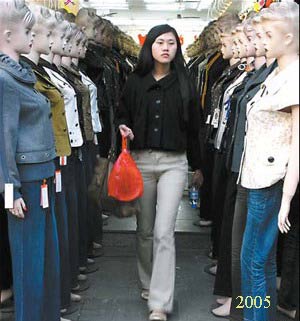
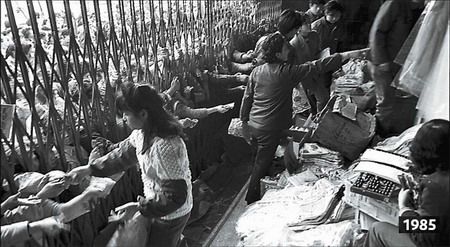 What you see in the black-and-white photo isn't a prison riot scene. It was an ordinary shop - ordinary in Chongqing in 1985, when the floodgate had just opened for residents of this largest Chinese city (population more than 30 million) to buy clothes styled differently than the ubiquitous Mao jackets. The passion of the customers almost matched that of a riot - so much so that the shop employees had to literally lock themselves behind a gate. There was no better way to keep their business in order. For economic officials in the distant capital city of Beijing, there was no fence to separate them from the nation's yearning for more variety and quantity. More often than not, more awkwardly than those beleaguered Chongqing shop assistants, they simply could not meet the demand due to the limited production and distribution infrastructure they had inherited from the era of the planned economy. And of course few outside the country at the time would come across a "Made in China" label except, perhaps, in the discount corners of some department stores. No one foresaw how the country would become a global supplier of textiles and garment.
While less than three decades, is reflected by the 2005 color photo, Chinese clothing stores now frequently contain more mannequins than customers. The number of companies and products has caused concerns about overcapacity. In 2005, according to industry sources, China made 46 billion garments, showing an annual growth of 11.2 percent. Of all the clothes, 85 percent were made in the six provinces of Jiangsu, Zhejiang, Shandong, Guangdong, Fujian and Hebei. Revenue from the domestic market that year totaled 682 billion yuan, or around $90 billion. Export manufacturers earned around $74 billion, after their average price per unit gained more than 11 percent over the previous year. However, the competitive glut of garment makers and sellers was not entirely due to Chinese efforts. Overseas capital played an important role in changing the landscape of China's clothing supply. Companies with overseas investors, including ones from Hong Kong and Taiwan, made up more than one-third of all garment companies. Also beginning with 2005, the industry began to quickly expand from the coastal provinces to the interior most noticeably in Henan, Jiangxi, and Hunan provinces. Among them, Henan, a traditionally agrarian province, would witness a more than 50 percent of annual growth in garment making. But the industry may be more dependent on foreign markets than foreign capital. In 2007, as the industry's exports exceeded $175 billion, it reported for the first time since 2003 an annual growth rate of below 20 percent. In the first two months in 2008, the demand was even more sluggish, with the industry's annualized growth falling to just above 5 percent. In some provinces, garment exports even showed negative growth. Eventually, some industry sources say, weak demand from the US and rising cotton prices may threaten as many as 15 million garment making jobs in China. The average profit margin for their employers, mostly small enterprises, is already as thin as 0.62 percent, which has driven them virtually to the brink of bankruptcy. No one has an exact figure of how many textile/garment companies there are in China, as officials of the industry association admit. But the large ones, meaning those each with at least 5 million yuan in revenue, number more than 40,000.

|
       |
南陵县| 时尚| 元朗区| 北宁市| 平泉县| 河北省| 五家渠市| 天津市| 新竹县| 锦屏县| 邵东县| 郓城县| 海门市| 镇安县| 老河口市| 柘荣县| 丰宁| 陆河县| 新巴尔虎左旗| 农安县| 双柏县| 三门县| 武功县| 永丰县| 库尔勒市| 桃源县| 张家川| 利川市| 宁晋县| 五莲县| 精河县| 长汀县| 江川县| 鄂托克旗| 大悟县| 和静县| 永康市| 康定县| 定兴县| 连城县| 秭归县|