

|
|
 |
|
30th Anniversary Celebrations
Economic Development
New Rural Reform Efforts
Political System Reform
Changing Lifestyle
In Foreigners' Eyes
Commentary
Enterprise Stories
Newsmakers
Photo Gallery
Video and Audio
Wang Wenlan Gallery
Slideshow
Key Meetings
Key Reform Theories
Development Blueprint
Li Xing:
Teachers like Li need our support  Alexis Hooi:
Going green in tough times   Hong Liang:
Bold plan best option for economy   New worlds
By You Nuo (China Daily)
Updated: 2008-04-21 17:13
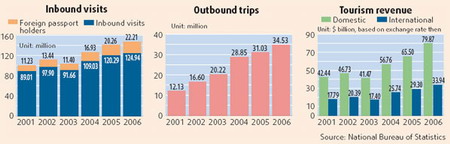
 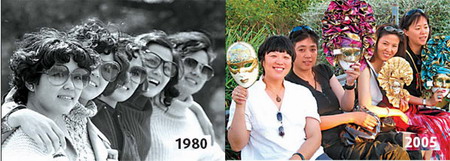 Don't be surprised. This is not an oddity column. Shown here are not quintuplets, or sisters from the same family. They are not related, but they all bore the same quant characteristic from an era that many young Chinese would recall as an ancient time. As shown in our black-and-white picture taken in 1980, many people were too shy or reluctant to display any distinctive, individual sense of fashion. People's fashion tastes and virtually everything they bought still bore the trace of the old State-imposed ultra-egalitarianism. Saying "me too" was the most convenient thing to do when people were not as ready to make individual choices. That was a time when factory workers cherished the luxury of just a little free time to get together in a small park - to see flowers, to poke a few jokes, and take some pictures (again, only black-and-white film was available). No barbecue, of course. Don't even plan any small snacks. That was a time when the food ration system was still partially in force. But unmistakably, people laughed. A young nation was ready to walk out of the shadow of its regimented, and sometimes harsh, past life to embrace new changes. Even though the five women did not spend much - except for a park admission of 0.05 yuan each, and five pairs of look-alike sunglasses - there was a sign of a blooming consumerism. At least they were not content to don their old Mao jackets anymore. In the 2005 color picture are Chinese touring Europe with their costly souvenirs from Venice. For that trip, each of the women in the picture must have spent some 15,000 yuan, or more than $2,000. We were not told if any of the women in the black-and-white picture also appeared in the color picture, though it is likely none did. But the fact is that many young factory workers in the 1980s did manage to change their lives in big ways between the 90s and now. And one change was the money and opportunity to tour other cities and foreign countries. The change was also reflected in the growing presence of foreign visitors in China. By the mid-1990s, the official statistic yearbook began to have one new item - "domestic tourism" - in its tourism section. It was reserved for reporting "hard currency" earnings from overseas tourists (including Chinese?from Hong Kong, Macao and Taiwan). By the 2000s, a category compiling "outbound tourists" was also included. In 2006, Chinese made 34.5 million overseas visits (including also Hong Kong, Macao and Taiwan). What the trend shows today is that the mainland is increasingly becoming a vibrant new force in world tourism.

|
       |
临猗县| 鹰潭市| 惠来县| 五莲县| 双鸭山市| 深泽县| 康马县| 巴东县| 乌海市| 琼结县| 安吉县| 定日县| 调兵山市| 岚皋县| 昌乐县| 渭源县| 平江县| 安新县| 孟州市| 华阴市| 抚顺市| 新蔡县| 大荔县| 常州市| 商水县| 岗巴县| 容城县| 霍邱县| 乐山市| 二手房| 勃利县| 济源市| 炉霍县| 永登县| 西城区| 达拉特旗| 桐梓县| 南投市| 抚顺市| 肥东县| 资溪县|



