|
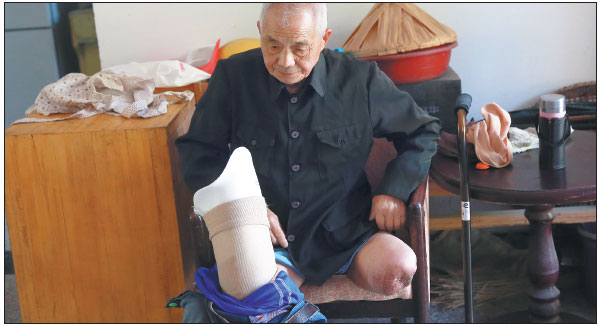
Xu Yusheng's legs began to rot when he was age 13. The 88yearold's left leg had to be amputated. Photos By Zou Hong / China Daily And Provided To China Daily |
Researchers say residents of villages in the provinces of Zhejiang and Jiangxi were probably infected with anthrax by the Japanese army during WWII. Zhao Xu reports.
Situated in the center of Quzhou, Zhejiang province, is the Quhua Hospital, affiliated with Quzhou Chemicals, one of China's largest producers of industrial chemical products. The hospital has a reputation for treating chemical burns. Zhang Yuanhai, a wound specialist and the hospital's deputy director, has personally operated on many of the patients with the condition.
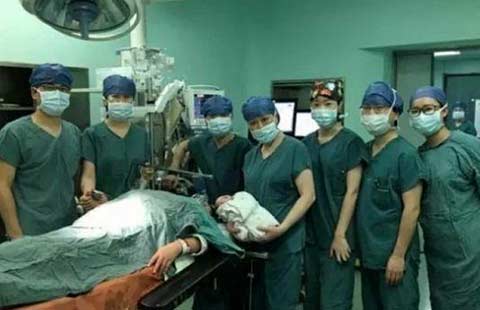
"'Rotten-leg disease' - that's how it's known here," the 49-year-old said. "Our treatment basically has two stages. First, the ulcers on the patient's legs are thoroughly removed and the area is cleaned. All the relapses over time have produced a thick, hard layer of tissue, like a board, within the damaged area. This has to be thinned to prepare for the skin graft that usually takes place 10 days after the initial surgery."
Skin from the head is used for the graft. "Skin from the scalp is preferred because it's thicker, more elastic and easier to grow. This gives the skin graft a higher success rate," Zhang said. "It usually takes about a week for the skin on the patient's head to grow back together and repair itself."
Five months after surgery, 79-year-old Chen Chunhua was recovering well. But for her children, the memories are still raw. "At one time, my mother's legs were rotting so terribly that the bones were almost visible," said Zheng Zhongguang, 56, Chen's oldest son. "The rotten part, so unsightly as to be almost beyond description, reminded me of the dregs left on a millstone after beans have been ground."
For many years, Chen relied on a herbal remedy for relief, using leaves picked from the nearby mountains. In the 1980s and 90s, she twice sought a cure in hospitals in Zhejiang and elsewhere, but was told that the only possible solution was amputation. She baulked at the idea, resorting instead to regular injections of antibiotics to battle the constant inflammation and occasional bleeding.
When the nightmare began, Chen had no idea what was happening. "I remember noticing a little red dot on my left leg. It soon turned into an itchy but painless blister which, after some scratching, bled and burst to form an ulcer with a hard center," she said. "That was really the beginning of my ordeal. I was about age 6 or 7 at the time, and my job was to tend the cattle every day."
For Wang Xuan, a long-time researcher into the Japanese army's use of biological weapons during World War II, Chen's words were the key that opened a door into the darkest chapter in the contemporary history of Zhejiang and neighboring Jiangxi province.
Between May and September 1942, Japanese troops launched a well-planned campaign against civilians in the two provinces as retaliation for a US Airforce bombing raid on Tokyo and other large Japanese cities.
The Japanese aimed to take control of the Zhejiang-Jiangxi Railway and also to destroy several airfields in the area that were used as Allied bases.
"Throughout the Zhejiang-Jiangxi campaign, the Japanese engaged in full-scale biological warfare. That operation was one of the largest germ warfare attacks they mounted in China during WWII, but there were also lots of ground troops," said Wang, whose interest in the subject dates back to 1994, when she was working for a company in the Kansai area of Japan and paid a visit to her hometown in Jinhua, Zhejiang.
"They used everything, from bombs containing germs and plague-infected fleas, to food and clothes carrying the same bacteria. The result was the outbreak of deadly diseases including bubonic plague, typhoid and cholera," she said.


Copyright 1995 - . All rights reserved. The content (including but not limited to text, photo, multimedia information, etc) published in this site belongs to China Daily Information Co (CDIC). Without written authorization from CDIC, such content shall not be republished or used in any form. Note: Browsers with 1024*768 or higher resolution are suggested for this site.
License for publishing multimedia online 0108263 Registration Number: 130349