|
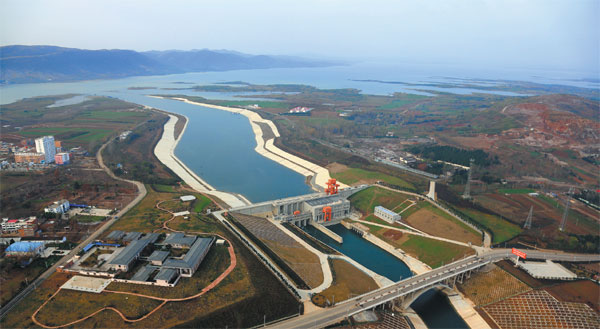
An aerial photo shows the main channel for the central route of the South-North Water Diversion Project in Dengzhou, Henan province. The project is the largest water-transfer undertaking in the world. Xinhua |
While the world's largest water-diversion project is bringing relief to China's dry northern regions, some residents in the south say they are paying a high price, but reaping few benefits. Wang Yanfei reports from Xichuan county, Henan province.
Nearly a year has passed since China's arid northern regions began receiving water channeled from the south via a network of pipes and aqueducts stretching more than 1,400 kilometers.
The three-phrase South-North Water Diversion Project, the largest water-transfer undertaking in the world, became operational in December last year, and is designed "to mitigate the water crisis and promote economic development in the north", according to the official website. The water, from the Danjiangkou Reservoir, which straddles the provinces of Hubei and Henan, is carried to the Beijing-Tianjin-Hebei cluster, a pivotal area for economic development in the north via the central route.
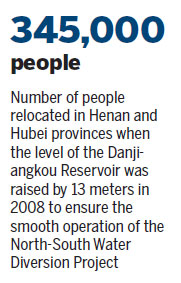
In 2013, the eastern route, which mostly follows existing channels, began carrying water to the provinces of Jiangsu and Shandong. Work on the central and eastern routes is ongoing, but the western route, designed to alleviate water shortages in landlocked Qinghai province, remains at the planning stage, and the extensive project "may take 40 to 50 years to complete", the website said.
In September, Beijing's groundwater storage capacity rose by 80 million cubic meters, the first rise in 16 years. "That's the result of the water diversion project," said Dai Yuhua, director of water resources at the Beijing Municipal Water Management Bureau.
By the end of October, more than 2 billion cubic meters of water had been delivered via the central route, and an estimated 3.7 million people had benefited, according to the route's management bureau. Now, 70 to 80 percent of the drinking, industrial and agricultural water used in Beijing and the nearby port city of Tianjin is piped from the reservoir, Xinhua News Agency reported.
Ni Guangheng, director of the Institute of Hydrology and Water Resources at Tsinghua University, who has visited a number of locations along the route, said the project was a sensible move.
"The demand for water has been rising for a very long time in the north, and the project has greatly eased the problem, judging by the statistics and the recent rise in the level of groundwater. But, the effect can't just be calculated simply by looking at the amount of money invested and revenues earned. As far as I am concerned, if it works well, then it's a good thing to do," he said.
"From the sole perspective of solving the water crisis, it is indeed a valuable project. Far more people have benefited than have been disadvantaged, and it's likely that more profit will generated by a hydroelectric project that will be put into use in the future," he added.
The project was inspired by a famous comment made by Mao Zedong in 1952, when China's then-leader noted that the south had plenty of water and joked that it would be wonderful if the north could "borrow" some.
However, despite its auspicious origins, the project was only approved by the State Council in 2002. The initial budget for the eastern and central routes was 124 billion yuan ($19 billion), but the real cost has almost doubled from the initial projections.
"We encountered a lot more problems than we had imagined," Wang Mengshu, a member of the Chinese Academy of Engineering and also a professor at Beijing Jiaotong University, told the 21st Century Business Herald. "The aqueducts, where the water is completely exposed to the air, cost more than expected, and more bridges needed to be built because the water channels cross numerous rivers and creeks on their way north."

Copyright 1995 - . All rights reserved. The content (including but not limited to text, photo, multimedia information, etc) published in this site belongs to China Daily Information Co (CDIC). Without written authorization from CDIC, such content shall not be republished or used in any form. Note: Browsers with 1024*768 or higher resolution are suggested for this site.
License for publishing multimedia online 0108263 Registration Number: 130349