|
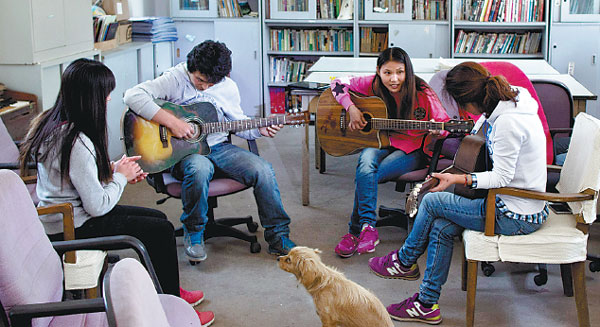
Students relax in the reading room during the lunch break. |
Running out of options
Sun has spoken with many migrant workers of different ages, but those born in the 1980s and 1990s strike him as being very different from their parents.
"Their parents left home in the 1980s to earn money in cities. They endured the harsh working conditions because they knew they would return home one day and spend their remaining years in the village. But the new generation of migrant workers has adapted to urban life, and they want to stay in the cities," he said.
Some members of the younger generation have no land to return to. Qin Chunxia, a 24-year-old student at the college said returning home is not an option for her, because she, her younger brother and sister no longer have fields to tend in her village in Liuzhou in the Guangxi Zhuang autonomous region.
"Our family of five used to rely on just a small patch of land assigned to my father in the 1980s, but it has been requisitioned. My parents now earn a small amount working on nearby construction sites or by helping other farmers grow watermelons," she said.
Moreover, many workers from rural areas don't even know how to work the farmland. Liang Dong, 32, said he had barely done any farm work before he left his village in Liupanshui in Guizhou province, at age 17. However, he wasn't sorry about that. "Farming is too tiring and the income is too low," he said.
Still, becoming a part of the city is equally hard.
Liang has lost count of the number of jobs he's had in the past 15 years, but none of them paid enough for him to settle down. He has lived and worked in a number of cities, and earned a living on construction sites, and as a waiter, factory worker, security guard and bookseller. He declined several offers to attend junior college, partly because he didn't want to use his parents' money at a time when he was unable to earn enough by his own efforts.
In April, the National Bureau of Statistics published a survey on the lives of migrant workers, which showed that their average monthly salary was just 2,864 yuan ($461) last year. Despite being a year-on-year rise of 9.8 percent, that increase is paltry when compared with soaring urban property price, especially in China's larger metropolises.
To earn an above-average salary, migrant workers usually have to work long hours. The NBS report said that most work 25 days a month on average, while 85 percent work more than 44 hours per week, and conditions are tough.
At her last job, at an electronic equipment factory in Shenzhen, Guangdong province, Qin was required to work 12-hour shifts, and "everyone had to work frequent night shifts, from 8 pm to 8 am, standing at their workstations all night long".
Sadly, these low-paid jobs often result in a lack of respect for the workers, and sometimes even humiliation.
Liang said the longest he ever stayed with one employer was a year, but he left the job - as a company security guard - because he felt he wasn't getting the respect he deserved. Things came to the boiling point when Liang refused to allow a white-collar worker to take a shortcut and enter the complex through the exit gate he was guarding. "He cursed me loudly because I stopped him, and eventually, we ended up in a brawl. My superior came, but did nothing about the man. I felt vexed at the level of disrespect shown to me," he said.
Lyu Tu, who has a PhD in developmental sociology, is a researcher at the workers' college. She has interviewed more than 100 workers and worked at two factories to gather material for her book China's New Workers: Culture and Destiny, published in January. Lyu discovered that many factory managers don't treat the workers as human beings, but as production tools. At one of her jobs, at a factory in Suzhou, Jiangsu province, she said the managers "never called the workers by their names", not to mention that the owners ignored the workers' calls for decent housing, medical care, elderly care and education for their children.

Copyright 1995 - . All rights reserved. The content (including but not limited to text, photo, multimedia information, etc) published in this site belongs to China Daily Information Co (CDIC). Without written authorization from CDIC, such content shall not be republished or used in any form. Note: Browsers with 1024*768 or higher resolution are suggested for this site.
License for publishing multimedia online 0108263 Registration Number: 130349