An important role
 |
|
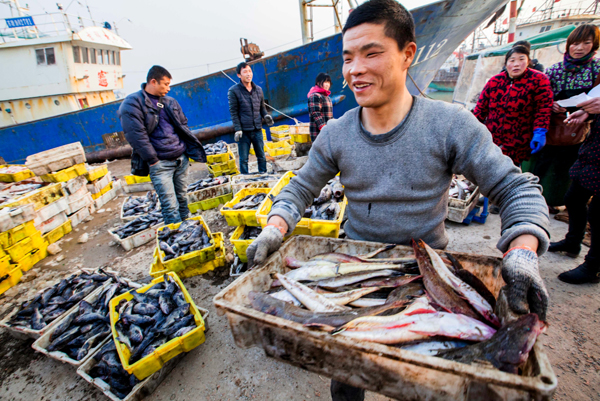
A fisherman carries produce at a port in Lianyungang, Jiangsu province. Local fishing resources have recovered in recent years thanks to artificial reefs and other measures for marine environment protection. SI WEI/CHINA DAILY |
In the 1980s, Shandong and Guangdong provinces undertook a number of reef pilot projects, but a lack of investment meant the scale was too small to be profitable or benefit the local fishing industry, according to Liang Zhenlin, director of the School of Marine Biology at Shandong University.
"Now, artificial reefs have spread along the coastline, from the Guangxi Zhuang autonomous region in the south to Liaoning province in the north. They play an important role in the rejuvenation of the underwater environment and replenishing the fish population," he added.
The function of the reefs varies according to location: Those in southern China are mainly used to promote environmental conservation efforts, while those in the north of the country are used in the production of high-end marine produce, including sea cucumbers and abalone, both of which are firmly in the luxury food bracket.
The country's vast 18,000-km coastline and the large expanse of water are advantageous for the development of artificial reefs, and could see China's system quickly outstrip those in Japan and the US, meaning that both the environment and the fishing industry could benefit over a shorter time scale.
In 2013, Dongtou, an island county in Zhejiang province, spent 230 million yuan on the construction of the country's largest artificial reef, dubbed the "ocean ranch", composed of 90,000 cubic meters of concrete blocks across 150 hectares of ocean, which has produced a marine-life propagation area of more than 1,000 hectares.
"If we don't start building more reefs now, it will be too late," said Lin Shaozhen, senior engineer at the Zhejiang Marine Culture Research Institute.
According to a 2014 report released by the State Oceanic Administration, China's fishery resources have declined rapidly in recent decades, especially bell fish and large yellow croakers. Some other species have simply vanished, and the proportion of high-end fish in the total annual catch fell to 30 percent from 50 percent in the 1960s.
"We are not only building reefs, but also cultivating and releasing various fish fry," Lin said, as she stood in a greenhouse-type structure that housed pools stocked with 40-day-old large yellow croakers that will be transferred soon to "sea ranches" and reach adulthood in six months. Lin said the reef will provide a natural habitat for the fry, which means their diet will be entirely natural and unaffected by human food waste.
Despite the acceleration in their development, the artificial reefs need to be regulated to ensure that they are effective and environmentally friendly, and their location and standards should be carefully assessed to prevent damage to the fragile maritime ecosystem, Lin said.
"More important, the restoration of the maritime environment requires a systematic approach that focuses on controlling pollution, preventing overfishing, and safeguarding the future for coastal people."
Contact the writer at peng-yining@chinadaily.com.cn

Copyright 1995 - . All rights reserved. The content (including but not limited to text, photo, multimedia information, etc) published in this site belongs to China Daily Information Co (CDIC). Without written authorization from CDIC, such content shall not be republished or used in any form. Note: Browsers with 1024*768 or higher resolution are suggested for this site.
License for publishing multimedia online 0108263 Registration Number: 130349