Pollution affects fertility
A report released by the Yangtze River Water Resources Commission of the Ministry of Water Resources earlier this year showed that the total volume of pollutants discharged into the river reached nearly 35 billion metric tons in 2012, a year-on-year increase of about 1.6 percent.
Moreover, a study conducted in 2009 showed that triphenyltin, a chemical applied to ship's hulls as a fungicide and antifoulant, is probably responsible for the reduction of the sturgeon's fertility in the wild.
Hu Jianying, a professor at the College of Urban and Environmental Sciences at Peking University who led the study, said even if the use of triphenyltin were to be banned, the chemical would have an impact on the local ecology for many years because of its slow rate of decomposition.
Other dangers facing the fish include injuries from ship's screws, or becoming tangled in fishermen's nets. China banned commercial fishing of the sturgeon in 1984, and established a 443 km nature zone for the endangered species in the river in 1987.
In 2005, the reserve was trimmed to 355 km so two giant hydropower plants could be built on the section between Xiangjiaba and Xiluodu on the upper reaches of the river.
The changes aren't just affecting the sturgeon, however. Since 2003, reproduction rates have fallen among several species, according to a 2009 report from the Chinese Academy of Sciences. Four major types of freshwater carp - black, grass, silver, and crucian - have also seen a steady reduction in numbers.
Restoring the population
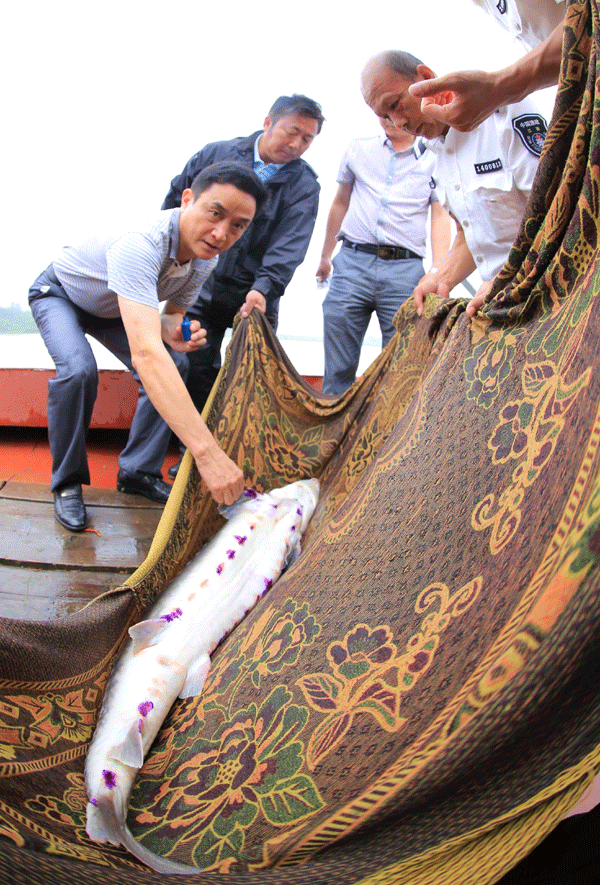
The Chinese sturgeon, known as the "living fossil" because it dates back to the Cretaceous period, is at the top of China's national wildlife protection list. Although it spawns in freshwater, the fry migrate to the ocean to mature.
Since the 1980s, fishery experts have been breeding sturgeons in captivity to stop the species from becoming extinct. Jiang said the China Sturgeon Institute's breeding program has developed every year since it started in 2009, and 60,000 fish were born in October.
In the past decade, the institute has released more than 5 million artificially bred sturgeon into the wild, but the continuing decline in numbers indicates that reintroduction isn't working well.
Wei said: "An artificially bred adult sturgeon only weighs about 50 kg and has low resistance to disease, whereas wild sturgeons weigh more than 225 kg and are stronger." He added that inbreeding makes successive generations less competitive when they are introduced to the wild.
Although the breeding program can never replace the large numbers of fish already lost, the reproduction program will be continued to help the species survive, he said.
He urged wider protection measures and called for the recovery program to be strengthened. "It's now or never," he warned. "If no effective measures are taken, this ancient fish may die out in the next few decades."

Copyright 1995 - . All rights reserved. The content (including but not limited to text, photo, multimedia information, etc) published in this site belongs to China Daily Information Co (CDIC). Without written authorization from CDIC, such content shall not be republished or used in any form. Note: Browsers with 1024*768 or higher resolution are suggested for this site.
License for publishing multimedia online 0108263 Registration Number: 130349