|
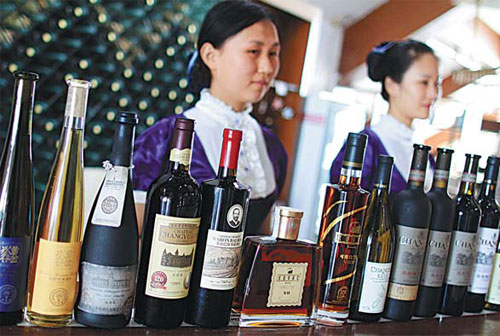 Staff members display wines made by the Changyu company at Chateau Changyu Castel in Yantai, Shandong province, during a promotional event. Zhu Xingxin / China Daily |
Cao said most of the 2,000 wineries that are expected to be operating by 2020 will have small-scale production levels of 150,000 to 200,000 bottles per year.
"It's like calligraphy. Everyone has his own style. We help wineries to become special and develop their own characters that can compete with top international brands."
Leading international players such as Pernod Ricard and Domaine Chandon are among those growing grapes and making wines in a region that "warmly welcomes" foreign investors.
Shen Yang, estate director of Domaine Chandon's Ningxia operation, said the debut of the wines in September was a great success. The company is redesigning the label and from the second batch onwards it will include the words "Made in Helan Mountain East Valley" in Chinese and English.
"We want Chinese consumers to be proud of products made in China," said Shen. "The origin label will promote our Chandon brand too. We are proud to tell everyone that the wine is from Helan Mountain."
Domestic investors
As well as international producers, investors from China have also shown great interest in the industry.
In Shanxi province, many people whose wealth came from the coal industry have ditched their old businesses and set their sights on opening wineries. Zhang Wenquan, president of Chateau Rongzi, is one of them.
He has found there are many advantages for energy enterprises that shift to wine since he established the chateau in 2007.
"The capital accumulated in the energy industry to some extent ensures the high quality of facilities, which paves the way for the use of advanced technology in the winemaking process, and therefore fine wine can be produced," he said. "It is also environmentally friendly and can benefit local farmers."
The provincial government has introduced policies aimed at changing the industrial landscape, which is based mainly on coal mining, to boost the economy in an environmentally friendly way. This has encouraged a growing number of coal companies to invest in vineyards.
Shanxi belongs to one of China's emerging wine-producing regions - the Loess Plateau. At around 800 to 1,200 meters above sea level with a continental climate, the main wine-producing areas in the province lie on roughly the same latitudes as Bordeaux.
Low rainfall, high levels of sunshine, a temperature difference of 15 C between day and night and sandy soil all contribute to the quality of the grapes.
"In good years, this region could produce the finest wine in China," Duan said.

Copyright 1995 - . All rights reserved. The content (including but not limited to text, photo, multimedia information, etc) published in this site belongs to China Daily Information Co (CDIC). Without written authorization from CDIC, such content shall not be republished or used in any form. Note: Browsers with 1024*768 or higher resolution are suggested for this site.
License for publishing multimedia online 0108263 Registration Number: 130349