 |
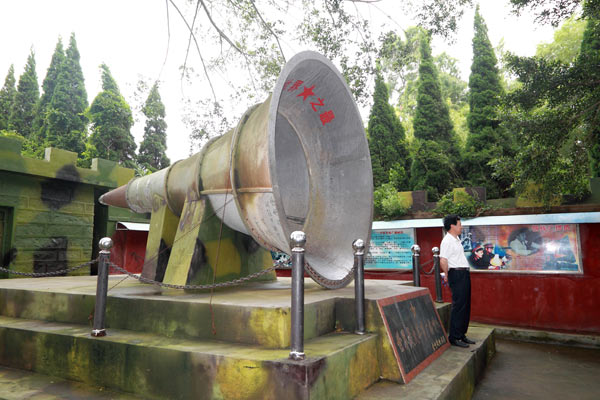
| A visitor poses in front of a loudspeaker on display in Xiamen. The horn is believed to be the world’s largest military broadcast speaker. LAN TIANYI / FOR CHINA DAILY |
The other side wasn't quiet either, according to Hong. When the Taiwan program started at night, flares rose from Jinmen, closely followed by the inevitable whistle of artillery shells.
One of the speakers destroyed in the raids is on display in the Military Museum of the Chinese People's Revolution in Beijing, where visitors can count as many as 100 holes in the unit.
|
Waiting for the mail First person |Hong Chunji, 60, (1971-89) It wasn't easy; in addition to doing the broadcasts, we were also soldiers, farmers and builders. We built our studio brick by brick, and grew our own food and, because there was a lack of fresh water, we built a pool to collect rainwater to wash our clothes in. The view was stunning, but it wasn't a vacation. On the contrary, it was exhausting and dangerous. In the hot humid Fujian weather, our broadcasting bunker was like an oven. Although a refreshing breeze blew most of the time, going outside wasn't a wise thing to do. One time, a shell landed in our kitchen 10 seconds after I left. Apart from us, there weren't many residents on the island, and to avoid attracting artillery fire, it was pitch black at night. We repeated the same tasks day after day. Life was tedious. The mailman was the visitor we really looked forward to seeing. He visited by boat once a week bringing newspapers and letters, our only form of communication with our families and the outside world. On very rare occasions, he brought some movies. Those days were like festivals to us. We watched the films in a cave, and hung a blanket over the entrance to cover the light of the projector. They were usually old movies, but we enjoyed them, even though we watched them hundreds of times. Ni Wen and Hong Chunji spoke with Peng Yining. |
Hong said the Jinmen side also fought back in the war of words.
"I remember that they said people in the mainland were so poor that they couldn't even afford a pair of trousers, and had to eat banana skins," he said. "As a teenager, I was curious about the propaganda and was confused sometimes, but I never doubted anything I believed. People were loyal to the official doctrine."
Broadcasters from both sides knew each other's names and backgrounds. Those on Jinmen even called out Chen's and Hong's names, promising them money if they crossed over, according to Hong. In response, the mainland side invited the Fujian-based uncle of one of the Jinmen broadcasters to talk to his niece and urge her to "come home".
Dreams and reality
Xu Bingying, 59, a Jinmen broadcaster, said that when she finally met some of the former mainland broadcasters face to face, it was like a dream that had become reality.
In 2008, Xu was invited to Beijing for a television show which featured some of the mainland broadcasters, including Chen Feifei. "I hugged Chen when we first met and we exchanged gifts. I always wanted to meet them after hearing their voice for so many years. Cross-Straits relations have improved tremendously, otherwise we couldn't have sat together, chatting and drinking tea," Xu said.
"Xiamen is not only close to Jinmen, but also shares the same culture as Taiwan," she added. "I am comfortable when I visit this city. A lot of Taiwan residents know the mainland through visiting Xiamen."
Ni Wen, 58, a mainland broadcaster between 1975 and 1980, said: "We've witnessed a great change in cross-Straits relations."
For Ni, the "Message to the Compatriots in Taiwan" - a communique issued by National People's Congress on Jan 1, 1979, that called for the reunification of the mainland and Taiwan - was regarded as the turning point in cross-Straits relations, and its publication resulted in changes in the content and tone of her program.
"The way we referred to our listeners changed. Instead of saying, 'Brother KMT soldiers and officers' we referred to them as 'Dear brother KMT soldiers and officers'. It took me a while to get used to adding 'dear' at the beginning," she said. "In response, the Taiwan broadcasts changed and echoed ours, becoming friendlier and more moderate."
During her free time, Ni sometimes peeked at Jinmen through a telescope. "I could clearly see soldiers jogging on the beach and playing basketball. When our program started, they stopped what they were doing - I could tell they were listening by the way their heads tilted. Sometimes the officers would blow whistles and drive the men away from the beach to avoid the broadcasts," Ni said. "I was so curious about Taiwan and what the people thought of our program."
Born and raised in Beijing, Ni said that when she wished the KMT soldiers a good time during traditional festivals, she felt homesick. "People are people," she said. "I missed my family in Beijing, and they missed theirs in the mainland."
In 2010, Ni made her first trip to Taiwan; the place was as beautiful as she had imagined. She made a point of visiting the grave of Deng Lijun, known as Teresa Teng in the West, a popular singer in Taiwan who died in 1995. Deng's music, predominantly soft, sweet love songs, was frequently played during the broadcasts from Jinmen, but was considered decadent and bourgeois in the mainland in the 1970s.
"I thought the songs were beautiful when I first heard them on the broadcasts," said Ni. "I liked them."
Signs and silence
As a result of the thaw in cross-Straits relations, the mainland stopped the frontier broadcasts in 1991, but it was another 10 years before those in Taiwan followed suit.
A sign, comprising eight characters written in red ink, was erected on the beach at Xiamen in the 1990s in front of an abandoned 30-speaker broadcasting tower. The characters, which face Jinmen, proclaim: "The 'One Country, Two Systems' Theory Unites China".
The sign, which is more than 10 meters tall and around 100 meters long - approximately the same size as the famous "Hollywood" sign in the United States - has become one of the city's most-visited tourist spots.
On the opposite side, "The Three People's Principles Unite China" - a political philosophy devised by Sun Yat-sen, which is a cornerstone of KMT thinking - is written in red on a white board which gleams in the sunlight and is clearly visible from Xiamen.
According to Professor Yang, the relationship is stable for now, even though uncertainties remain and exchanges are mostly limited to top officials and business people.
"Xiamen provides the perfect opportunity for the grassroots of both sides to get to know each other better," he said.
Contact the writer at pengyining@chinadaily.com.cn

Copyright 1995 - . All rights reserved. The content (including but not limited to text, photo, multimedia information, etc) published in this site belongs to China Daily Information Co (CDIC). Without written authorization from CDIC, such content shall not be republished or used in any form. Note: Browsers with 1024*768 or higher resolution are suggested for this site.
License for publishing multimedia online 0108263 Registration Number: 130349