Program aimed at saving newborns triggers controversy, reports Dong Fangyu in Tianjin.
It was about 4 am when four men jumped out of a taxi and left a baby at a small, nondescript house in Tianjin. A letter tucked inside the child's clothes simply noted its birthday and medical record.
Unlike those left outside in the cold or in a dumpster, this baby was lucky.
 |
|
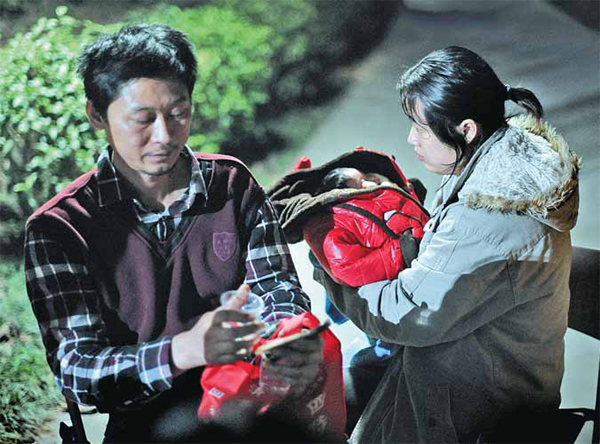
This couple from Guangzhou came to the hatch intending to give up their baby daughter, but later abandoned the idea. [Photo by Mo Weinong/For China Daily] |
The 13-square-meter house is warm and cozy. A crib, an incubator, an air purifier and ventilating equipment are lined up against the pink wallpaper, dotted with moons and stars.
By mid-March, the Tianjin baby hatch, which only opened at the start of the year, had received 35 abandoned infants.
Situated at the gate to the Children's Welfare Institute, a government-run orphanage, the baby hatch - also known as a babies' safety island - allows desperate parents to leave unwanted newborns, press an alarm button, and depart anonymously.
After a delay of about five minutes, someone from the institute will arrive to retrieve the child.
But facilities such as this have come under fire recently. While some people have embraced the idea, saying it protects the lives of unwanted children, critics argue that it encourages the unscrupulous to abandon such infants, which is illegal in China.
For some, the influx of abandoned babies simply highlights defects in the child welfare system.
It's difficult to obtain statistics about the number of abandoned children in China, but the 2010 China Child Welfare Policy Report, released by the China Philanthropy Research Institute, estimated that 100,000 babies are abandoned every year, most of them with disabilities and illnesses.
In July, when the Ministry of Civil Affairs launched a pilot project to set up baby hatches across China, Tianjin was one of the first cities to launch a facility. To date, there are 24 baby hatches in 10 provinces, municipalities and autonomous regions. A further 18 regions are preparing to open facilities by the end of the year, according to the China Center for Children's Welfare and Adoption.
Safeguarding babies
|
 |
|
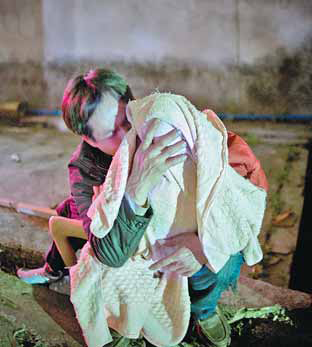
A father from a county in the northern hills of South China’s Guangdong province says goodbye to his baby outside the hatch in Guangzhou. [Photo by Mo Weinong/For China Daily] |
Xu Shuming, who is in charge of the reception of unwanted children and their subsequent adoption at the institute, is also in favor of the project. "Before the baby hatch came into use, the babies we took in were usually brought by the police. They had been found at bus stations, public rest rooms, or parks; it could be anywhere. One baby we received last year was almost frozen to death," she said.
On the face of it, baby hatches can only be a good thing. Last year, an abandoned baby was found with ants crawling on her face in Henan province; in another case, a newborn child was trapped in a sewer pipe after his mother gave birth above a squat toilet in Zhejiang province.
Contrary to many preconceived ideas about the Chinese preference for male offspring, gender discrimination is not the sole reason babies are abandoned. According to Xu, all 35 babies left in the Tianjin hatch have severe disabilities and illnesses, such as Down syndrome, cerebral palsy, and congenital heart disease.
"Not a single baby left at our hatch has been in a good condition. Some (of the illnesses) are fatal and emergent; some will have to be cured through years of treatment," said Xu.
Many welfare experts said families too poor to pay for expensive medical treatments believe that dropping a child off at the baby hatch may be the last gateway for survival.
"Some babies left in the hatch came with letters, cash, medical records or souvenirs such as a bracelet or an amulet tucked inside their clothing," said Xu.
The message may only be a few lines scribbled on a scrap torn from a cigarette pack, marking the date of birth, or it could be a letter that runs to thousand of words, depicting the family's desperate predicament.
"For our part, we hope parents will leave more information with their unwanted babies, such as medical records (usually handwritten to preserve anonymity) so that we can understand the real situation, avoid repeated medical checkups, and save time," Xu said.
 |
 |
| Xiamen's safe haven receives 1st unwanted baby | Baby hatches reveal deficient children's welfare |

Copyright 1995 - . All rights reserved. The content (including but not limited to text, photo, multimedia information, etc) published in this site belongs to China Daily Information Co (CDIC). Without written authorization from CDIC, such content shall not be republished or used in any form. Note: Browsers with 1024*768 or higher resolution are suggested for this site.
License for publishing multimedia online 0108263 Registration Number: 130349