Nationwide changes
Similar rules have been enforced across the country. "There are no plants, balloons or banners in the meeting rooms," said Liu Weilin, spokesman of the Beijing People's Congress Standing Committee.
"Before the meeting, we imposed a number of strict restrictions to reinforce the message that delegates shouldn't accept gifts or attend lavish banquets," he said.
The new ruling came as a relief to some delegates from the business sector. "Before, I had to attend several business-oriented banquets every day, but this year I can enjoy dinner with my family," said Chen Juli, a member of the CPPCC Guizhou provincial committee who is also chairman of Huanya Media Group.
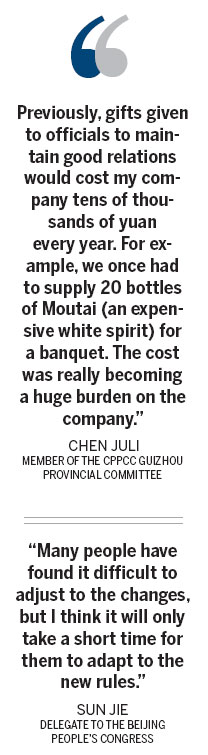
"Previously, gifts given to officials to maintain good relations would cost my company tens of thousands of yuan every year. For example, we once had to supply 20 bottles of Moutai (an expensive white spirit) for a banquet. The cost was really becoming a huge burden on the company."
Du Zhaohui, a member of the CPPCC Henan provincial committee and also chairman of Henan Dongan Car Group, said: "We've seen fewer banquets this year. At this year's two sessions, deputies and members have turned to Weibo (the Chinese equivalent of Twitter) or WeChat (a mobile text- and voice-messaging service) to keep in touch, instead of having meals together as we used to as an aid to maintaining strong personal relationships. "
At the suggestion of the Shanghai organizers, for the first time delegates were not allowed to smoke during meetings, and booths selling expensive food products and rare stamps, a tradition during the annual meetings, were removed from the venues to encourage delegates to focus more carefully on the business in hand.
The aim of the reforms is to allow deputies and members to attend the sessions with a single goal in mind - to focus on the content of the meetings and pay close attention to improving people's livelihoods, said Shum Yamwa, a Hong Kong-based member of the Shanghai CPPCC who is also president of Heal Force Bio-Meditech Holdings Ltd.
Paradigm shift
Sun Jie, a delegate to the Beijing People's Congress and chairman of the Beijing Food Association, said: "I know that some delegates have wondered if the changes have been excessive. Fruit used to be provided in the delegates' room, but not this year."
"Many people have found it difficult to adjust to the changes, but I think it will only take a short time for them to adapt to the new rules," she said.
Others wondered whether the changes are merely cosmetic and feared that old habits may be revived over time.
"If the changes are ignored or abandoned quickly, they will just be seen as lip service to the ideas of frugality and simplicity, " said Chen Yu, a philosophy professor at East China Normal University and a member of the Shanghai CPPCC. He claimed that some officials have adjusted their working styles temporarily, simply for the sake of appearances.
"Once the CPC Central Committee stops giving strict, regular warnings about bureaucracy and extravagance, members are likely to revert to their previous practices," he warned.
Instead of focusing on the number of meetings canceled or the savings made through budget cuts, deputies said the real issue is that the changes are aimed at serving the people in a down-to-earth manner.
"If a meeting is held with the aim of solving the problems related to the provision of people's basic needs, it doesn't matter if it lasts two extra hours. However, by the same token, empty talk is unnecessary and pointless," said Chen.
Li, from the Shanghai CPPCC, said that although officials in government departments and State-owned enterprises have been banned from hosting or attending lavish banquets or giving gifts bought with public funds, private businesses are not subject to the regulations.
"Some heads of private enterprises still invite officials to banquets and entertainment, and they're always willing to foot the bill," said Li, a research fellow at the Shanghai Institute of Microsystem and Information Technology at Chinese Academy of Sciences.
"That sort of behavior could provide opportunities for businesspeople to bribe officials and develop other ways of exchanging money and power. The new rules are part of an attempt to ensure that isn't allowed to happen," he said.
Contact the writer at zhouwenting@chinadaily.com.cn
Tang Yue and Yang Wanli contributed to this story.
Copyright 1995 - . All rights reserved. The content (including but not limited to text, photo, multimedia information, etc) published in this site belongs to China Daily Information Co (CDIC). Without written authorization from CDIC, such content shall not be republished or used in any form. Note: Browsers with 1024*768 or higher resolution are suggested for this site.
License for publishing multimedia online 0108263 Registration Number: 20100000002731