Low utilization rate
Although "Beijing Cough", the rasping respiratory ailment that's become associated with the Chinese capital in recent years, has attracted worldwide attention and resulted in some expats relocating to healthier climes, airborne pollution is far worse in smaller industrial cities, especially those in Hebei.
"No one - those who formulate national policies, environmentalists, the general public and the market - will allow Hebei to continue supporting industries that produce high levels of pollution but few benefits," said Zhou Benshun, Hebei's Party chief. "Projects that are profitable in the short term but do long-term damage will not be tolerated in the future."
Shijiazhuang, Baoding, Xingtai, Tangshan, Handan, Langfang and Hengshui, the seven cities on the nation's most-polluted list, have one thing in common: each is home to at least one highly polluting industry, such as coal, steel, cement and glass.
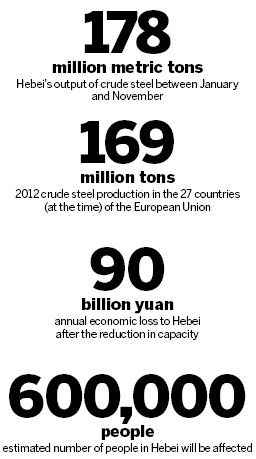
Hebei produced about 178 million metric tons of crude steel between January and November, outstripping the 169 million tons produced in 2012 by the 27 countries (at the time) in the European Union, according to the World Steel Association's Steel Statistical Yearbook 2013.
The high concentration of steel works in Hebei is evident from the comparative sizes - the EU covers an area of approximately 4 million square kilometers, more than 20 times that of Hebei.
Although steel production is high, the utilization rate of 72 percent is low. In the United States and Japan, a rate lower than 78 percent is normally deemed overcapacity, according to China Metallurgical News.
Although some small companies went to the wall during the market downturn, others, especially, private enterprises, maintained profitability by lowering their costs through the use of cheaper, lower standard raw materials, by purchasing older machinery and equipment from rival companies or by blatantly ignoring government antipollution regulations, said Xu Xiangchun, information director of the industry consultancy Mysteel.
In an attempt to solve the problem, the central government plans to cut 80 million metric tons of steel production capacity nationally by the end of 2017, according to guidelines issued in October. Hebei will be required to cut 60 million tons out of the national total, while Tangshan, a city located close to Liu's orchard, alone has a reduction quota of 40 million tons.
Copyright 1995 - . All rights reserved. The content (including but not limited to text, photo, multimedia information, etc) published in this site belongs to China Daily Information Co (CDIC). Without written authorization from CDIC, such content shall not be republished or used in any form. Note: Browsers with 1024*768 or higher resolution are suggested for this site.
License for publishing multimedia online 0108263 Registration Number: 20100000002731 










 Op Rana
 Berlin Fang
 Zhu Yuan
 Huang Xiangyang
 Chen Weihua
 Liu Shinan