Internet guidelines
The rising number of cases of violence in hospitals has prompted some unofficial Internet sites to provide guidance for doctors. The guidelines involve 31 points, the last of which is usually: "Remind yourself that the patient sitting in front of you might take you to court."
"If this sort of violence continues, doctors won't fully devote themselves to saving lives. We are not respected or protected, so who will save us while we are saving others?" asked Yu Keyi, a physician at the Peking Union Medical College Hospital in Beijing.
 |
|
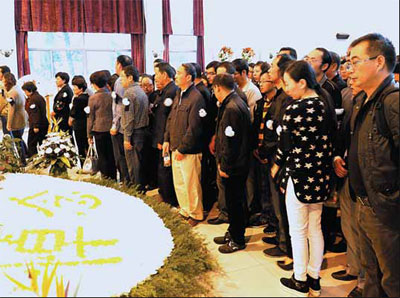
People pay their respects to Wang Yunjie, the doctor who died in the attack at Wenling No 1 Hospital in October. Wu Pengfei / for China Daily |
The National Health and Family Planning Commission recently announced plans to provide better security at hospitals.
Last year, the commission and the Ministry of Public Security released a joint announcement in which they pledged to guarantee the safety of hospital workers. However, the current situation has failed to satisfy the physicians.
"What we have right now is just a few security guards armed with nightsticks. Some of them are older than 50 and would be ineffective if a serious incident occurred. Also, clinical rooms are rarely fitted with alarm bells," said Yu, who worked in Saint Louis in the United States for six months late last year.
Yu said he was impressed by the guards at US hospitals, and by the plans formulated to ensure the safety of medical staff. "There is detailed guidance on how to deal with hospital violence. Classification of incidents is color-coded, so people are aware of the nature of any incidents and are able to impose a measure of control even at the inception. Security checks are also mandatory," he said.
Yu said the guards and security checks are a practical response to the threat posed by violent patients and can help to alleviate problems. "We doctors should stick to the ethics of our profession. If we are good doctors first and foremost, we will gain respect," he said. "However, I also think we urgently need a specific law to guarantee our safety."
Core values
Liu Xiaojing, 33, worked as a registered nurse in Singapore, for 18 months from the start of 2010. She said that in Singapore both the patients and hospitals have a highly developed understanding of the law.
"Once a medical-negligence case is filed, both parties seek a solution through legal channels rather than by fighting. The hospitals all have dedicated lawyers and the patients can get help from the local community," she said.
Dissatisfied patients can register complaints and provide hospital authorities with feedback when they are discharged. "But I didn't hear anyone using bad language or acting violently in the hospital, unlike in China, where this has become almost commonplace," she said. "When we were hired, we were also given training sessions about the hospital's core values, which emphasized the service attitude we should adhere to."
China's hospitals are not listed as public security protection areas, which means that violent offenders in hospitals can't even be charged with causing a public disturbance. Experts are now calling for the public security bureau to include hospitals in the list of public security protection areas and have urged laws to provide medical professionals with improved levels of protection.
Contact the writers at yangwanli@chinadaily.com.cn and pengyining@chinadaily.com.cn
Copyright 1995 - . All rights reserved. The content (including but not limited to text, photo, multimedia information, etc) published in this site belongs to China Daily Information Co (CDIC). Without written authorization from CDIC, such content shall not be republished or used in any form. Note: Browsers with 1024*768 or higher resolution are suggested for this site.
License for publishing multimedia online 0108263 Registration Number: 20100000002731 








 Op Rana
 Berlin Fang
 Zhu Yuan
 Huang Xiangyang
 Chen Weihua
 Liu Shinan