 |
|
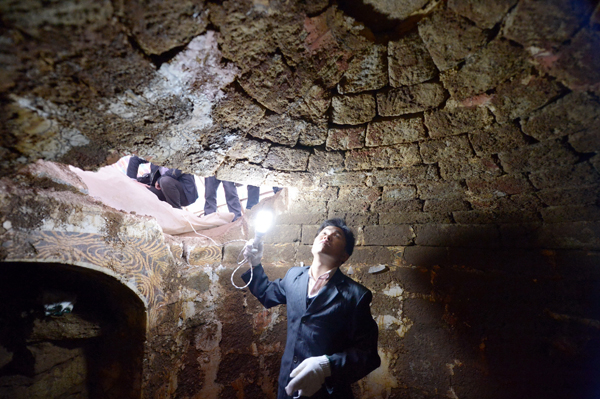
An archeologist studies murals in a tomb from the Ming Dynasty (1368-1644), which was found in Xingzi, Jiangxi province, during construction work. [Photo/Xinhua] |
No easy answers
There are no easy answers to the problem, according to Wang, who said if anyone is to be held responsible, it would have to be various levels of government, especially those at provincial, county and village levels.
The indifference of those in direct charge of tomb security, and their sometimes thinly veiled cooperation with criminals, disturbs the 52-year-old.
Wang, who has lowered himself into several thousand ancient tombs during his three-decade career, recalled a teacher-cum-tomb protector he knew in his native Jiangsu province in the 1980s. "He was the only holder of this official position in his county; he familiarized himself with every known tomb site in the area and kept a close eye on them the way a mother would her toddler," said Wang.
"Although he retired nearly two decades ago, the county museum is still home to the many earthenware utensils and gold accessories he managed to save just moments before their planned disappearance, sometimes risking his own life in the process."
Even though the cultural relics bureaus are employing more "tomb protectors", Wang complained that the positions are often handed out as sinecures as a result of nepotism.
However, the archeologists and historians admitted - with some reluctance - that a dark secret exists within the archeological world.
"You may not believe it, but on, admittedly infrequent, occasions, archeological teams have actually let the tomb raiders do their work while they waited in the wings," said Ni Fangliu, a writer-historian whose 2008 book The History of Chinese Tomb Raiding is considered a seminal work, both for its rigorous scholarship and its highly engaging style of writing.
The cardinal rule
The policy that still serves as the cardinal rule for Chinese archeologists was first shaped more than half a century ago and may be partly to blame for the present situation, according to Ni, who said, "The roots of this very strange scenario lie in the past as much as the present."
In 1956, the biggest archeological project of the era, the excavation of the Ming Dynasty (1368-1644) Dingling Mausoleum, eventually got underway after long debate.
During the following two years, countless treasures were unearthed at the site, but an invaluable discovery became a permanent loss.
The archeological teams lacked adequate conservation skills and gorgeously brocaded silk fabrics, preserved in pristine condition by the lack of oxygen in the tomb, quickly lost their luster and some simply disintegrated.
At that point, Zhou Enlai, China's premier at the time, stepped in. He made it clear that there would be no more "active archeological excavation" on Chinese soil, only "rescue missions".
In practice, it meant that the archeologists would not be allowed to excavate ancient burial sites unless their survival was in danger, either by large construction projects or by being plundered by unwelcome visitors.
The only sites exempt from the ruling were those whose excavation was deemed absolutely essential for studies in the related areas.
Over the past decade, as free-diving tomb raiders punched a couple of million holes in the ground in search of graves, the policy has been widely questioned.
The main criticism is that it deprives archeologists of the chance to make their own "pre-emptive strikes".
Copyright 1995 - . All rights reserved. The content (including but not limited to text, photo, multimedia information, etc) published in this site belongs to China Daily Information Co (CDIC). Without written authorization from CDIC, such content shall not be republished or used in any form. Note: Browsers with 1024*768 or higher resolution are suggested for this site.
License for publishing multimedia online 0108263 Registration Number: 20100000002731 








 Op Rana
 Berlin Fang
 Zhu Yuan
 Huang Xiangyang
 Chen Weihua
 Liu Shinan