


Time to get straight to the point


Individuals vs the system
 |
Their professional immaturity was highlighted and magnified in the aftermath of the Wenzhou rail accident in 2011, when two high-speed trains collided, claiming 40 lives and injuring nearly 200 people.
After explaining that the front of one of the trains had been buried a short while after the incident as a measure to ease conditions for rescue workers - a move that triggered widespread public dismay because the carriage still contained many bodies - Wang Yongping, the spokesman for the Ministry of Railways, told reporters, "Whether you believe it (the explanation) or not, I believe it."
The public was outraged by Wang's statement and he was later removed from his post.
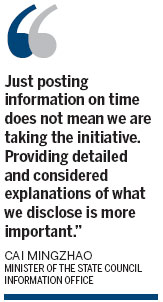
"People only see the performance of the individual spokesperson, but not the system behind us," said Mao, who is now the spokesman for the National Health and Family Planning Commission.
"This has to do with everyone in the organization; if the spokesperson doesn't have all the information, he has to collect it from various departments. But what happens if the spokesperson pushes for answers, but other people don't respond?"
Also, because Chinese spokespeople are usually administration officials of varying rank, rather than media professionals, they are unable to attend high-level meetings and therefore often lack the necessary information or experience that would be helpful when dealing with the media, said Hu Zhengrong, vice-president of the Communications University of China.
"We have regulations regarding the transparency of government information, but they aren't fully implemented. That's why still many people find our government mysterious," said Hu.
"Of course, we can't release State secrets. No government in the world does that, but we are still too conservative in many areas."
Credibility gap
 |
In one famous case, after a reporter blew the whistle on allegedly corrupt acts by Liu Tienan, who was then chief of the National Energy Administration, on the Internet in December, the administration's spokesman refuted the story just four hours later, declaring it "nonsense". However, Liu was later sacked from his post and is now under official investigation.
"Things like that do great harm to the credibility of spokespeople," said Hu.
Shi Anbin, one of the teachers at the 2003 training camp, said that during the past decade, the scope of those attending his media training courses has widened from spokespeople working for the central government, to those in local departments, and, more latterly, the politicians themselves. In the last 10 years he has trained more than 10,000 people.
He noted that while an ability to deal with the media is a basic qualification for politicians in the West, many in China still have limited knowledge and experience.
"Some attendees have been mayors for 20 years, but have never talked on TV - that would be beyond imagining in the US. In the era of the Internet, it is outdated for senior officials not to have social media accounts," he said.
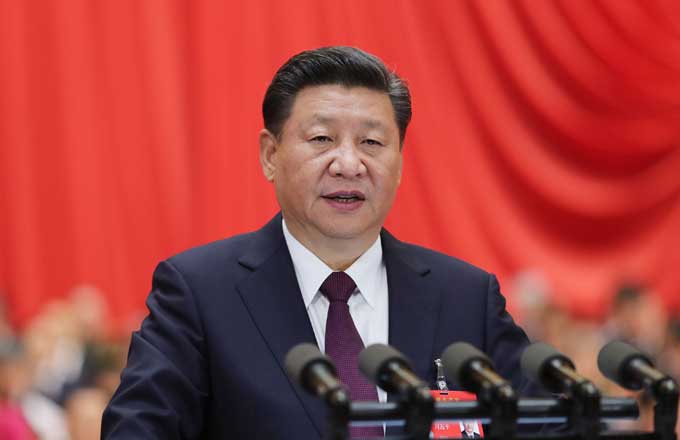
In a speech at the Central Party School in 2009, Xi Jinping, the then principal, asked officials to improve their ability to deal with the media, a move related to the stability of the Party's ruling status.
"More officials with spokesperson experience are promoted now. And hopefully, that will encourage more people to speak to the media and break away from the traditions of 'Silence is golden' and 'Loose lips sink ships'," said Shi.
Contact the writers at tangyue@chinadaily.com.cn and caoyin@chinadaiy.com.cn
Shan Juan, Yang Wanli and Zhao Xu contributed to this story












Registration Number: 130349


