Adjacent to the Humble Administrator's Garden, the Suzhou Museum, also designed by I. M. Pei, has the characteristics of a garden of Suzhou style, including the symbolic white walls and gray tiles. Instead of using traditional clay tiles, Pei used gray granite for the roof. A modern steel structure was also used for the new museum in place of traditional wooden roof beams.
|
 |
|
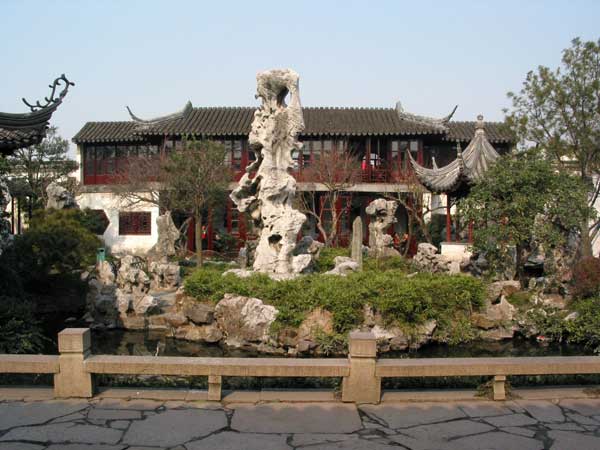
Lingering Garden, one of the classical traditional gardens in Suzhou, Jiangsu province, has been known for its special rockeries although it contains all the delicate glamor of typical parks that are centuries old. PHOTOS BY GAO ERQIANG / CHINA DAILY |
As well as the museum, many other facilities in Suzhou are inspired by the traditional gardens. Decorated with bamboo and featuring a wooden frame and white ceiling, the Suzhou train station looks like a huge pavilion from a distance.
Most of the city's bus stations are built with verandas. Walking along the city's streets, visitors sometimes notice tiny leafy gardens with windows decorated with traditional lattice, and think they are another historical site, until they see signs, usually tucked into thick bushes, reading "Public Toilet".
In Shanghai, a modern living area has adopted the design of classical gardens and has more than 300 villas built in the traditional Chinese style.
In Beijing's Taoranting Park stand nine pavilions, all copied from famous ancient Chinese landscape sites, which were given a national architecture prize in the 1980s.
Liu Shaozong, the pavilions' designer, said the beauty of classical Chinese gardens has also been adopted overseas.
In a book he published in the 1990s, he featured more than 50 gardens overseas that used traditional Chinese landscaping.
In 1981, the Ming Xuan classic Chinese garden was added to the Metropolitan Museum of Art in New York as a permanent artwork.
In Suzhou's garden museum, there is a black and white photograph of then US president Richard Nixon shaking hands with the Chinese craftsmen who went to the US to build Ming Xuan, which was designed to resemble the Master of Nets Garden in Suzhou.
Located among deep alleys, the Master of Nets Garden doesn't have as many visitors as other tourist spots in the city. The best time to visit the garden is before dusk falls, when the bamboos shine under the sun against the white walls and great bursts of ivy leaves flow from the lattice windows.
Dragonflies skim along the pond, leaving ripples, then rest on a 130-year-old wisteria, which entwines the ceiling of the veranda.
The garden is small. The diameter of the pond is less than 20 meters, said Liu. "But the beauty, and the artistic environment it creates, is international."
In 1984, the Suzhou Classical Garden Construction Company built a Qi-Fang pavilion in Water Moon Park in Ikeda, Japan. In 1986, the Dr. Sun Yat-Sen classical Chinese garden was founded in Vancouver, Canada.
In 1992, the Suzhou institute of landscape architecture designed a Chinese Garden in Singapore.
"Besides the artistic concerns, the traditional designs are also very practical and can be improved and widely used in modern landscaping," said Wang Jintao, professor of landscaping at Beijing Forestry University and an active designer in the capital city. He said a lot of his projects are inspired by traditional Chinese gardens.
"They are simple and elegant. They encompass the principle of 'Less is more'," he said. "You can find their influence in your life, from five-star hotels to the iPhone."
In addition to the garden's form, Lou Qingxi, the researcher of ancient architecture, said it is the philosophy of traditional Chinese landscaping the world has been appreciating.
In the Humble Administrator's Garden, there is a pavilion called "With Whom Shall I Sit?", he said. "The name comes from a poem, 'With whom shall I sit? The moon, the breeze and myself.'
"The pavilion is located at the bend of a slender stream and creates a romantic scene that has no trouble, no noise, just the moon and the breeze," Lou said. "I believe modern people still want a space suitable for leisure and relaxation."
Although the beauty of classical Chinese gardens is universally acknowledged, plans should be adjusted to local conditions, said Liu, the designer.
A curved rooftop makes a building seem more alive but is not practical in northern China, where hash winds blow most of the time, he said.
"A small pond is elegant in a Suzhou garden, but would be frozen in winter in Beijing. And I have seen people copy a garden but carve poems into the handrails, when they are supposed to be displayed on walls and pillars. A professional designer would never do this," he said.
"Classical Chinese gardens are a combination of architecture, history and culture. You have to understand that before you imitate it."
Copyright 1995 - . All rights reserved. The content (including but not limited to text, photo, multimedia information, etc) published in this site belongs to China Daily Information Co (CDIC). Without written authorization from CDIC, such content shall not be republished or used in any form. Note: Browsers with 1024*768 or higher resolution are suggested for this site.
License for publishing multimedia online 0108263 Registration Number: 20100000002731 









 Op Rana
 Berlin Fang
 Zhu Yuan
 Huang Xiangyang
 Chen Weihua
 Liu Shinan