Three new lines
The network will have three lines, eastern, central and western, and will run from Kunming to Singapore.
The eastern line will run from Kunming, via Mengzi and Hekou, in Yunnan, to Hanoi and Ho Chi Minh City in Vietnam. It will then continue on to Phnom Penh in Cambodia, Bangkok in Thailand, Kuala Lumpur in Malaysia, and right through to Singapore, its final destination.
 |
|
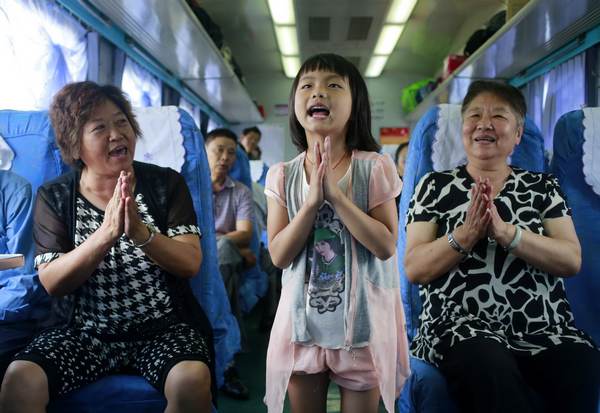
Xiang Jinyue, 7, sings as she travels with her grandparents on the Kunming-Mengzi train. Photo by Feng Yongbin / China Daily |
The western line will travel through Dali and Ruili in Yunnan province, to Yangon in Myanmar and then on to Bangkok. The section between Kunming to Dali has already been completed.
The central line will run from Kunming to Jinghong, also in Yunnan. Later, if negotiations are successful, it will progress at Vientiane, the capital of Laos, and then Bangkok.
The new network will replace the existing Yunnan-Vietnam Railway, which is solely a cargo route between the two countries. However, the railway's low speed had long impeded bilateral trade.
The Mengzi-Hekou Railway, designed to run at 120 km per hour, will improve the transport capacity of Sino-Vietnamese trade and also aid exchanges among other Southeast-Asian countries. The railway authorities and local residents are confident that the new network will bring advantages to the region.
So far, 64 percent of the new Mengzi-Hekou Railway has been completed. The 143-km-railway, which will carry both passengers and cargo, is scheduled to begin operating in late 2014, according to Kunming Railway Bureau.
The line will have 32 tunnels and 36 bridges, accounting for 76 percent of its total length. So far, 29 of the tunnels have been completed, but the construction teams still have 4,858 meters of tunnel left to drill, the bureau said.
Taiyangzhai is one of six tunnels longer than 5 km. Their construction has presented the team with huge challenges, both physical and mental.
On June 22, Xie and 10 of his co-workers were sitting next to three large blocks of ice produced in the icehouse at the tunnel entrance. "Every 40 or 50 minutes, we must stop for a while and come out to cool off," said Guo Xinghai, 33.
The tunnel burrows through a chain of hills that rises to an average height of 500 meters. A 450-meter-long relief line, set at an angle of 45 degrees to the main shaft, carries away the broken rock and other waste from the construction process. The air in the main tunnel often becomes stagnant and the temperature soars whenever the boring machine is in operation. When the workers were reinforcing the walls, the fresh concrete gave out more heat and the temperature often rose to 45 C, said Jiang.
Even when the workers were motionless, it was easy to see the sweat drenching their skin despite the half-light in the wide tunnel. When a couple of colleagues and I visited the site to witness the construction work on June 23, we found it hard to breath after just 30 minutes in the tunnel. At a width of more than 3 meters, it can easily accommodate the motorcycles that some of the workers use to save time getting in and out.
The suffocating atmosphere has scared Jiang many times, but never more than when workers faint and fall limply to the ground. They are always sent for treatment at the nearest hospital, about 40 km distant. "I have fainted in the tunnel three times and on one extreme occasion I knew I was falling, but my body wouldn't follow my mind," he said.
Jiang ordered the workers to install air blowers to lower the temperature: "However, because the tunnel is 3.5 kilometers long, the two air blowers were unable to provide fresh air, and so we spent a further 100,000 yuan to install six more."
"Last week, when three workers fainted, they were foaming at the mouth. I was really scared. What if someone died in the tunnel? The conditions mean that many of the workers quit after just a short time. They say, 'I prefer having my life to having money'. The harsh conditions mean being safe is more important than earning cash."
Jiang has 10 "brother" workers who have helped him build tunnels on a number of important railway lines, such as the Wuhan-Guangzhou High-Speed Railway.
Other than these stalwarts, Jiang regards some of the other workers as migratory birds - since construction began, 1,000 of them have left the site after just one or two days.
Copyright 1995 - . All rights reserved. The content (including but not limited to text, photo, multimedia information, etc) published in this site belongs to China Daily Information Co (CDIC). Without written authorization from CDIC, such content shall not be republished or used in any form. Note: Browsers with 1024*768 or higher resolution are suggested for this site.
License for publishing multimedia online 0108263 Registration Number: 20100000002731 








 Op Rana
 Berlin Fang
 Zhu Yuan
 Huang Xiangyang
 Chen Weihua
 Liu Shinan