Migrant workers without proper registration unable to make themselves at home in the cities, Jiang Xueqing reports in Beijing.
Wang Jun, 46, came to Beijing from a small town in Fengyang county, Anhui province, in 1994. He opened a hair salon with his wife in a residential area in Dongcheng district and made around 40,000 yuan ($6,458) a year. Two years later, their son was born in the capital.
However, Wang's household is still registered in Anhui province. The family left their hometown long before China's social security system was launched and therefore has no right to social security or health insurance in either Beijing or Anhui.
 |
|
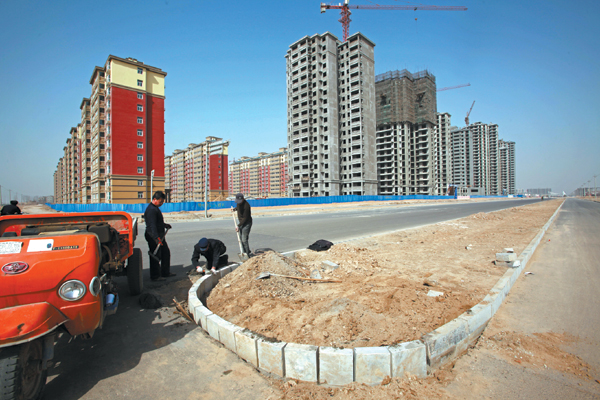
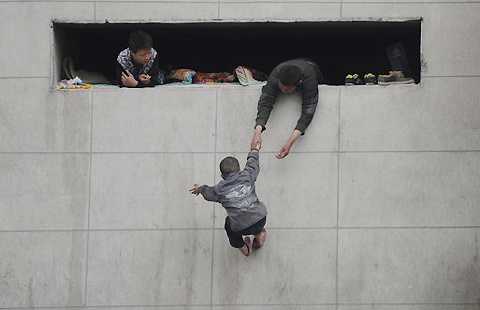
A new residential area for farmers in Huaxian county, Henan province, is under construction. According to the local government, about 1.8 million farmers became city residents in the province by the end of 2012, pushing the urbanization rate up to 42.2 percent. Wang Zirui / for China Daily |
As a result, they have to cover their medical expenses in full every time a family member goes to a hospital.
Wang's son attended primary and secondary schools in Beijing. But last year, at the age of 16, he had to return to Anhui and enroll at a local high school so he can take the gaokao, or college entrance exam, in 2015. Without a Beijing hukou, China's system of household registration, the young man is not allowed to take the exam in the city where he was born.
"I've been living here for almost 20 years, but I still don't feel like a Beijing resident," said Wang, who is now looking to the government to eliminate the policies that affect migrant workers and relieve the family's concerns about social security, health insurance and their child's education.
Those problems may well be answered soon. The central government is working on a national plan for urbanization, which is likely to be launched before the end of the first half of this year. One of the key ways of measuring the relative success or failure of the policy will be how well the government handles the task of ensuring that every citizen gains an equal share of the benefits of urbanization.
The plan aims to boost domestic demand and provide a guideline for the healthy and orderly development of urbanization, said Zhang Ping, then chairman of the National Development and Reform Commission, at a media briefing during the first session of the 12th National People's Congress in Beijing.
The government has introduced the strategy at a time when economic crises in Europe and the United States have caused a continuous decline in overseas demand for Chinese goods, and as the authorities seek a solution to the overcapacity that afflicts the manufacturing sector.
In the meantime, the migrant worker population hit 262.61 million in 2012, according to the National Bureau of Statistics. If such a large number of people were to be reclassified as city residents the subsequent upsurge in demand would be huge.
"Urbanization is the key to China maintaining economic growth and 'soft-land' its economy," said Wen Tiejun, dean of the school of agricultural economics and rural development at Renmin University of China.
Chi Fulin, president of the China Institute for Reform and Development, said urbanization will accelerate the transformation of the economy from an export-driven model to one based on domestic consumption. If successful, the move could sustain GDP growth of 7 to 8 percent in the coming decade.
Planners will encourage urban agglomeration, gradually reclassify migrant workers as urban residents and promote equal access to basic public services. They will also coordinate the development of different-sized cities and small towns, and increase the urban population capacity by strengthening the economy, infrastructure, natural resources and environments in the cities.
During this year's meetings of the National People's Congress and the Chinese People's Political Consultative Conference, local officials eagerly promoted the construction of city clusters, such as Chengdu-Chongqing in Southwest China, where large urban areas in close proximity employ increased collaboration between local governments, and combine the use of resources. Some of these clusters are huge; one example is the urban sprawl in the middle reaches of the Yangtze River where 40 cities, with a total combined area of nearly 440,000 square kilometers, house approximately 160 million people.
Copyright 1995 - . All rights reserved. The content (including but not limited to text, photo, multimedia information, etc) published in this site belongs to China Daily Information Co (CDIC). Without written authorization from CDIC, such content shall not be republished or used in any form. Note: Browsers with 1024*768 or higher resolution are suggested for this site.
License for publishing multimedia online 0108263 Registration Number: 20100000002731 








 Op Rana
 Berlin Fang
 Zhu Yuan
 Huang Xiangyang
 Chen Weihua
 Liu Shinan