Floating carcasses prompt safety concerns


The discovery of a huge number of dead pigs floating in rivers, lakes and streams in the area around Shanghai has once again put China's livestock and food industries in the spotlight. Report by Wang Hongyi in Jiaxing and He Na and Xu Wei in Beijing
Zhulin village in Jiaxing city, Zhejiang province, is one of China's largest pig-breeding centers. As you drive along the road towards the village, the air reeks of pig feed and the smell of manure becomes overwhelming. The residents joke that if they close their eyes while traveling by train, they never miss their station simply because the smell tells them exactly where they are.
The ochre-colored, two-story houses are scattered across the village, and compared with the noise on the road, the place is quiet, except for the squeals of the pigs.
Despite its status as a center of pork production, the village was largely unknown to the outside world until early March, when it gained national notoriety.
 |
|
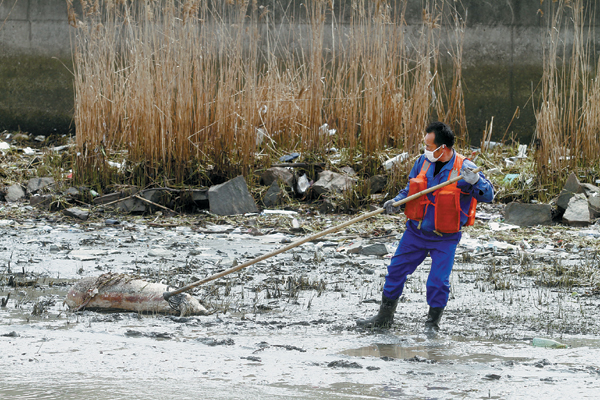
Sanitation workers retrieve dead pigs from the Huangpu River in Shanghai. [Photo by Xing Kong / for China Daily] |
Zhulin became a household name after reports on March 5 that huge numbers of pig carcasses, an abnormally high proportion of them piglets, had been discovered floating in the waters of Shanghai's Huangpu River and rivers and lakes in neighboring Jiaxing.
In the past few days, around 9,500 carcasses have been fished out of the Huangpu River - which supplies 22 percent of Shanghai's tap water - according to the Shanghai Municipal Government. Media reports have put the number of carcasses in the region at 13,000.
And that number keeps rising, albeit slowly, even as the clean up operation continues. The authorities said tests have revealed no abnormalities in the water quality in either Shanghai or Jiaxing, or in the pork on sale in local shops and markets.
Information found stamped on, or cut into, the pigs' ears prompted the authorities in Shanghai to pinpoint Jiaxing as the source of the carcasses, a claim denied by the town government. In response, it published a newsletter in which it argued that as a major producer the city attaches great importance to the correct disposal of carcasses.
However, even Yu Kangzhen, chief veterinarian with the Ministry of Agriculture who led a team to investigate the case, has been unable to accurately locate the source. According to Xinhua News Agency, Yu said tests carried out on the pigs ruled out the possibility of any epidemic affecting swine in Jiaxing, and he attributed the high number of deaths to common infections caused by the changeable weather.
The large number of small piggeries in Jiaxing mean it's common to see dead swine in the farmyards and abattoirs. However, if the animals have died of disease, the local farmers will often dump the carcasses in rivers or on rural roads, Yu added.
Related:
- No Zhejiang dead pigs enter market: official
- Shanghai authorities retrieve dead pigs from river
- Panic over dead pigs prompts satire
- 46 jailed for selling meat from sick pigs
- Large-scale pig plague denied
- Probe launched into dead pigs found in river
- Pig virus detected in Shanghai river water
- More dead pigs found floating in river
- 1,200 dead pigs retrieved in Shanghai river