The lessons learned from SARS


Contingency plans
China learned valuable lessons from the SARS outbreak; in the years that followed, the government took effective measures to handle bird flu, H1N1 flu and hand, foot and mouth disease.
 |
|
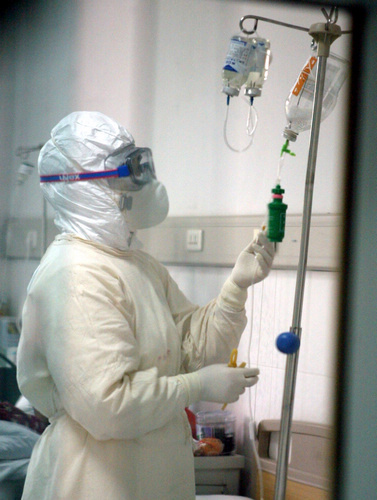
A doctor checks a patient's drip bottle at Beijing Ditan Hospital, one of the facilities that played a key role in the treatment of patients. [PHOTOS BY XU JINGXING / CHINA DAILY] |
For example, not every health bureau at the district and county level has an independent emergency response office. The operation of some of the fever clinics set up at general hospitals after the SARS outbreak is inefficient as a result of a slackening of vigilance among administration officers and medical personnel, said Tang.
In some cities, emergency supplies are not renewed promptly based on evaluation and the suggestions of the experts. Doctors and nurses at general hospitals need more training to improve their knowledge of, and sensitivity to, contagious diseases. Meanwhile, although contingency plans have been formulated, emergency response drills should be practiced more frequently and become a regular practice, he said.
China has built a nationwide monitoring network for contagious diseases, but the network is not very effective at the grassroots level, according to Zhong; first, because of a lack of knowledge about testing technologies among local medical professionals, and second, because officials in some provinces are wary about releasing accurate figures on the number of deaths, for fear of damaging their political standing.
Zhong said government investment in the healthcare system only accounts for 5.5 percent of China's GDP, that's lower than in many other developing countries.
"Looking back over the past 10 years, the government has paid more attention to the well-being of the people, but not enough attention. We've made huge progress, but our footsteps are slow, especially in terms of healthcare," he said.
Contact the writer at jiangxueqing@chinadaily.com.cn
Related:
Recalling the past, looking to the future