Relocation: the move into modernity


 |
|
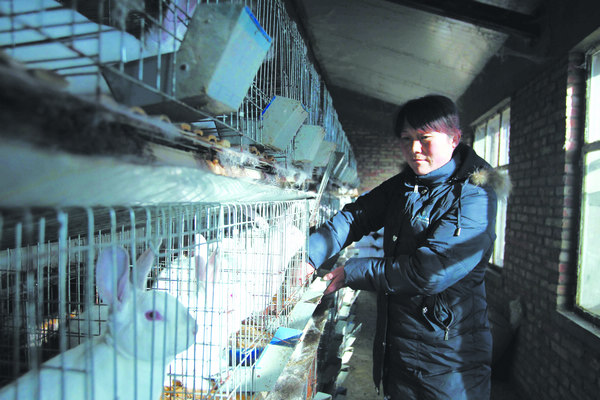
Xu Chunqing's living standard has improved since she began to raise rex rabbits. Last year, the 40-year-old earned 100,000 yuan from her work. |
Industrial chain
For the middle-age group that grew up in villages and used to scratch a living from the land, urbanization has brought greater job opportunities and the chance to earn a higher income. That has promoted a change in skills.
Xu Chunqing is among the tens of thousands of residents of Inner Mongolia that have undergone the transition to an urban lifestyle. The 40-year-old mother of two lives in Dongda village, part of Dalate town, close to the east end of the Kubuqi desert in north Ordos. Last year, she earned 100,000 yuan, double the salary of a local government officer.
She earns her money by raising rex rabbits, a breed noted for its velvety fur. "Not every inch of Inner Mongolia is covered by grass and good for sheep and cattle. We live close to the desert, so farming can only provide just enough food to feed the family," she said.
Dongda village has a population of 120,000. About 10,000 families breed rex rabbits and foxes. Because the gravely soil provides poor farmland, young people worked in laundries or as waiters, nannies or security guards.
Starting in 1998, Xu worked as a dishwasher for almost 10 years, earning approximately 800 yuan per month for a 10-hour day, six days a week.
In 2009, she received a job offer from Dongda Corp, a local enterprise that has invested 10 billion yuan to support the rural poor. "I'd never heard of raising rabbits for profit before, so I only bought 72 from the company," she said.
Despite her doubts, Xu earned 2,300 yuan from the first batch of rabbits, which she sold after four months. That prompted her to quit her dishwashing job and sign a contract with the company to oversee two hutches, each containing 1,000 rabbits.
In the years that followed, Xu raised around 6,000 rabbits in the hutches annually, bringing an annual income of 100,000 yuan. She bought a car last year and plans to sign a contract for another 20 hutches. "I felt proud because I earned more than my husband," she said.
However, Xu's family is just one aspect of the environmental-friendly industrial system operating in the village. The local farmers have given up subsistence farming and have turned to cultivating sand willows.
The local soil is perfect for the hardy trees; a single sapling will grow to maturity in a year and, helpfully, grows more rapidly after the branches have been snapped off. The fresh leaves and saplings provide good food for the rabbits, and the wood can be used to produce furniture.
Rabbits, mink, raccoon dogs, foxes and wolves have become an industrial chain; the fur is used in the manufacture of clothing and the rabbit meat is processed for consumption. Small quantities of wolf meat are used in conjunction with herbs in the preparation of local, traditional medicines.
The chain not only makes full use of the materials at hand, but also protects the environment. It has provided a boost to local employment and brings a reliable income to the previously impoverished residents. Now, the village is aiming to raise more rabbits, increasing the number from 30 million to 100 million during the next five years.
For Xu, the move to the town has paid unexpected dividends. A decade ago, the family could not have supported a second child, but now her younger daughter, aged 4, is enrolled in a private kindergarten.
"Moving to the city is a dream for many villagers. It not only means better living conditions, but also a brighter future for the next generation," she said.
Contact the writers at wanghao@chinadaily.com.cn, yangwanli@chinadaily.com.cn and yangfang@chinadaily.com.cn
Related:
Urbanization set to boost growth
A better lifestyle for elderly residents