Cold snaps in southern China have triggered rising vegetable prices, disrupted transport and reignited debate over central heating, as He Na, Hu Yongqi and Zhang Yuchen report.
Huang Hui, a 33-year-old English-language teacher at a Shanghai university, once had a coveted job as team leader with a multinational company in Beijing.
She may have realized her ambition of becoming a project manager had it not been for her parents, who constantly reminded her it was time to get married and settle down.
 |
|
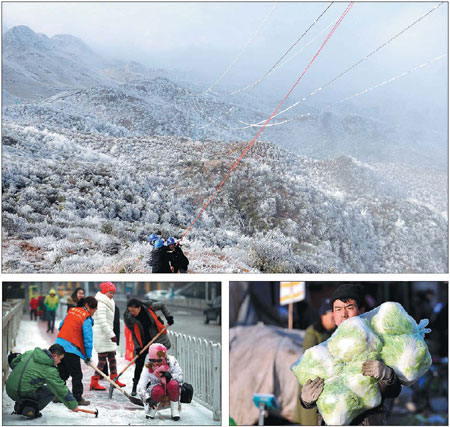
Clockwise from top: Workers remove ice from a cable in Weining county, Guizhou province. South China was hit by cold weather in early January, with the average price of vegetables rising continuously for 10 weeks. Residents try to clear ice from the street in Chenzhou, Hunan province. Tao Liang / Xinhua He Maofeng / for China Daily Zhan Yan / Xinhua |
Instead, Hui decided to leave the capital almost three years ago to pursue an academic career, living a quiet but independent lifestyle.
However, her peace and quiet ended in May when her mother suddenly arrived in Shanghai, ostensibly to look after her daughter's health, but doubtless to point her in the direction of marriage.
Huang racked her brains about how she could persuade her mother to return to Beijing but constantly failed. As the temperature began to fall, their time together became strained, and at weekends they frequently didn't talk. Huang sat, cloaked in a blanket, watching films on her laptop, while her mother wore two sweaters, a vest and a down jacket in the sitting room to watch TV.
Just as Huang came close to despair, to her surprise her mother suddenly packed her bags just after Christmas and said she would return to Beijing - and a heated home - as she could no longer stand the cold in Shanghai. "It turned out the cold was too much for her. Even though I was also complaining about the cold weather all the time, at least it came to my rescue," Huang said.
But her relief lasted only days, as Shanghai has no citywide central heating system like Beijing. Even though she uses an electric blanket and air-conditioner at home, Huang still misses the cosy feeling of living in a centrally air-conditioned home.
Heating system
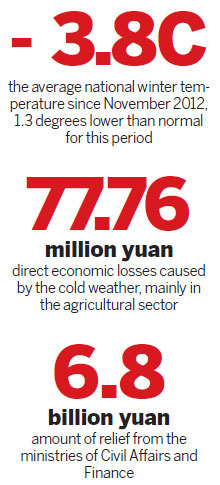
China is experiencing its coldest winter in 28 years, with the average national temperature remaining at - 3.8 C since November 2012, which is 1.3 degrees lower than normal for this period, according to sources from the China Meteorological Administration.
Huang found that after home and marriage, the cold weather is the third topic on the list for discussion at gatherings she joined.
"The winter here is really chilly. When can the south have central heating? If the weather continues to be severe next year, I may go back to Beijing to surrender to my parents," she said.
Huang's feelings are shared by millions living south of the Qinling Mountain-Huaihe River line, a boundary drawn by the government to save money in the 1950s, with areas to the south of the line not receiving central heating.
As it is not the first time in recent years that the south has been hit by severe cold spells, many residents are calling for new central heating systems to be installed in southern cities - with the calls becoming increasingly stronger this winter.
Zhang Lin, owner of a mobile trading company in Suzhou, Jiangsu province, who gave birth to a daughter less than two months ago, is one of those appealing for warmth.
"Except for the fine days, which can be counted on both hands, after my daughter was born, almost all the days have been bleak and unpleasant. The room is dark, without sunshine and chilly," the 31-year-old said.
"Even I have to put on more clothes to keep warm inside the room, let alone the baby. She's very sensitive to the air conditioner, so we turned it off. I know babies should never be overclothed, but fearing she may get cold, I have to put more clothes on her. She obviously doesn't like wearing too much as it hampers her movement," Zhang said.
"Why not establish a central heating system in the south? If the cold snap continues, how can my baby and I get through the days? She's too young to fly to my relatives in the northeast, where apartments are centrally heated. I can hardly stand these wet, cold days anymore."
Xu Guangjian, vice-president of the School of Public Management at Renmin University of China, said establishing central heating in southern cities will benefit residents and raise their living standards in winter.
However, this will not be easy. Walls of buildings in the south are generally thinner than those in the north, and windows are single-glazed, which makes it hard to retain heat. The cost would also be huge and if developers transferred this to consumers, would they have the ability or want to pay? Xu said.
Experts warn that many challenges lie ahead before the nation can expand its central heating coverage, including sourcing the massive investment that will be required, and persuading residents it is essential to build new thermoelectric power stations near their homes.
After numerous cold spells, many provinces and regions in the south have launched frost warning signals.



Copyright 1995 - . All rights reserved. The content (including but not limited to text, photo, multimedia information, etc) published in this site belongs to China Daily Information Co (CDIC). Without written authorization from CDIC, such content shall not be republished or used in any form. Note: Browsers with 1024*768 or higher resolution are suggested for this site.
License for publishing multimedia online 0108263 Registration Number: 130349