Bare-chested protests
On Nov 29, some 20 male research and development engineers who were part of the group forced to go "on vacation" staged a protest at Sinovel's Beijing headquarters, standing bare-chested in the snow to attract public attention.
The company also cancelled prospective employment agreements with a number of graduates in 2012, including Yin Wei, aged 24. After four years of studying at North China Electronic Power University in Beijing, one of China's leading schools in the power industry, Yin felt his employment prospects were good and signed an agreement with Sinovel in September 2011, when many of his peers were just starting to search for jobs. Sinovel offered an annual 3,000 yuan for interns and around 2,000 yuan more for full employees, a salary that satisfied Yin.
 |
|
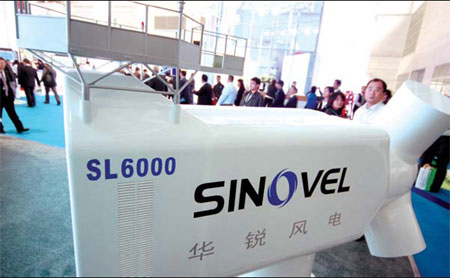
Visitors examine a model of a Sinovel Wind Group turbine. The company is one of China's leading manufacturers of large-scale onshore, offshore and inter-tidal equipment. Wu Changqing / for China Daily |
However, in May 2012, as Yin was celebrating graduation with friends, he was told the agreement had been terminated. With compensation of 2,000 yuan, Yin and two classmates were forced to return home to find jobs.
"I was confident and proud to be a member of Sinovel at first, but the cancellation (of the agreement) changed my career and life," said Yin. "It was too late to find a high-quality position, because most companies had completed their recruitment by May."
Eventually, Yin found a job with a transmission-tower manufacturer in his hometown of Chengdu, capital of Sichuan province. "I'm extremely interested in facilities research and development, but in the new factory I can't choose what I do, and my gross salary is no more than 2,000 yuan a month, a mere 40 percent of what I had expected," he said.
A member of Sinovel's press relations team declined to answer questions put to her by China Daily.
"Sinovel has made great forward strides in the past few years, but the foundation of its development is not solid enough," said Ma Xuelu, vice-chairman of the China Wind Energy Association. "The company focused on expanding production capacity rather than making the necessary technical innovations. This is a typical phenomenon in the Chinese wind power industry."
In addition to the lack of innovation, the adjustment of industrial policies, and fierce competition, are also blamed for the sectoral profit slump.
Also, a number of local governments that approved wind farm construction to pursue GDP growth have ignored the fact that the local grid network lacks the capacity for long-distance power transmission.
Provisional regulation
To control the development of the wind power industry, China's National Energy Administration issued a provisional regulation in August requiring that any future plans for wind farms with a capacity of at least 50,000 kW must obtain approval from the central government as well as the provincial authorities.
When considering projects with a capacity of less than 50,000 kW, provincial governments have to make a decision based on their annual plans for wind farm construction and development. The plans, which are submitted to the National Energy Administration, should include the total construction scale and a separate application for each project.
By Dec 18, the NEA had approved plans for wind farms with a total capacity of 54.11 gW.
"The Chinese wind power industry has developed too quickly during the past five years and a large number of companies, some without the requisite experience or skills, have entered the industry," said Ma Jinru of Goldwind.
"Many wind turbine manufacturers bought technical drawings to rapidly accelerate their production capacity and start commercial production, but the wind turbines they produced were far below international quality and performance standards."
The chaos that followed resulted in a drop in the price of wind power equipment. The average price of a 1.5 mW wind turbine - the model most frequently used in China - fell to 3,800 yuan per kilowatt by the end of September 2012 from 6,000 yuan in 2008.
As competition intensifies and the government raises the technical bar for wind farms to connect to the grid, industry experts predict that a larger number of companies will be forced out of the sector in the next three years. In the meantime, China will remain as a major global market for wind energy equipment manufacturers.
Wu Wencong contributed to this story.
Contact the reporters at jiangxueqing@chinadaily.com.cn and huyongqi@chinadaily.com.cn


Copyright 1995 - . All rights reserved. The content (including but not limited to text, photo, multimedia information, etc) published in this site belongs to China Daily Information Co (CDIC). Without written authorization from CDIC, such content shall not be republished or used in any form. Note: Browsers with 1024*768 or higher resolution are suggested for this site.
License for publishing multimedia online 0108263 Registration Number: 130349