Face masks
"If he hadn't had a fever today, I wouldn't have brought him to the hospital. I'm afraid the pollution will only make his cough worse," said the mother of a 7-year-old boy being treated at the China-Japan Friendship Hospital on Sunday. Parents and children at the hospital wore face masks.
"It only takes me 10 minutes to cycle to work, but when I get home my mask is gray and filthy. It's just terrible," she said.
 |
|
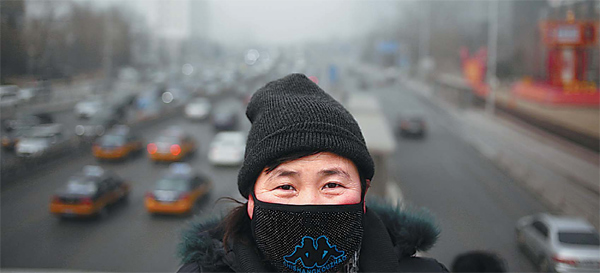
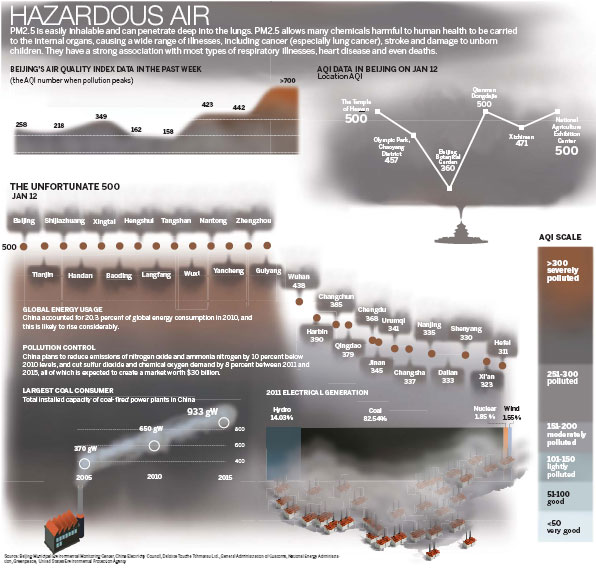
Beijing saw PM2.5 density climb higher than 900 micrograms per cubic meter on Saturday. The World Health Organization considers 25 micrograms per cu m to be a safe daily level.[Wang Jing/China Daily] |
Hospitals in Beijing and in the provinces of Hebei and Hubei have reported a rise in the number of patients with respiratory conditions during recent days, according to local media.
In 2012, an estimated 8,572 premature deaths occurred in Shanghai, Guangzhou, Xi'an and Beijing. They were a direct result of high levels of PM2.5, according to a report co-authored by Peking University's School of Public Health and Greenpeace. Meanwhile, the World Health Organization estimates that air pollution caused approximately 470,000 premature deaths in 2008.
Continuous, large-scale pollution in the form of smog will create panic among the public and cause people to question the government's handling of environmental issues, according to the China Council for International Cooperation on Environment and Development.
The growth and severity of PM2.5 pollution in recent years is directly related to the rapid rise in coal consumption, allied to an increase in vehicle exhaust emissions. Although cities such as Beijing and Guangzhou are leading the way in the reduction of coal use in absolute terms, air pollution naturally moves with the air currents, meaning some cities share each other's polluted air. The Ministry of Environmental Protection is encouraging places such as the Beijing-Tianjin-Hebei region, the Yangtze River Delta and the Pearl River Delta to unite to combat pollution.
Since the start of the month, 74 large cities in China have provided daily readings of PM2.5 that are available to the public. As the data becomes more widely available, China is working on a national surveillance and risk-assessment network on the health impact of PM2.5, said Xu Dongqun, deputy director of the institute of environmental health and related product safety at the Chinese Center for Disease Control and Prevention.
"The planned network, the first of its kind on the mainland, will study the exact links between major pollutants, particularly PM2.5 and help the authorities to issue public health warnings ahead of the worst days whenever possible," she said.
By studying data from air-quality monitoring stations and records of hospital visits, plus medical and mortality records, the system will provide specific warnings and advice to help the public to protect themselves, explained Xu, although she was unable to provide an exact timetable.
The network will start in Beijing, before being rolled out nationwide as the air-quality monitoring data become more widely available across the mainland, she said. "The health impact of the fine particulates varies regionally and among differing population groups."


Copyright 1995 - . All rights reserved. The content (including but not limited to text, photo, multimedia information, etc) published in this site belongs to China Daily Information Co (CDIC). Without written authorization from CDIC, such content shall not be republished or used in any form. Note: Browsers with 1024*768 or higher resolution are suggested for this site.
License for publishing multimedia online 0108263 Registration Number: 130349