Can Brazil do what Britain did? Yes, if it thinks it can
Updated: 2012-08-14 07:57:53
( China Daily)
|
|||||||||||


|
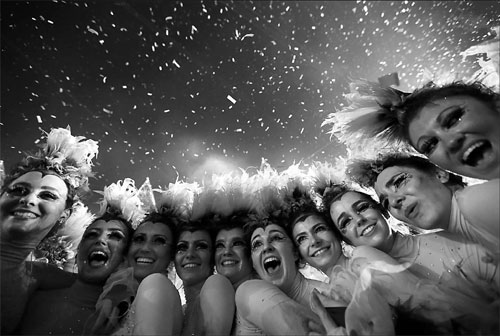
Colorful performers pose at the end of the closing ceremony of the London Olympic Games at the Olympic stadium on Sunday. The countdown begins to the 2016 Games in Rio de Janeiro. [Photo/Agencies] |
If the wall of noise from an Olympic home crowd were a banned substance, Team GB would have been kicked out of the London Games on day one.
Judging by the host nation's record haul of 65 medals, 29 of them gold, its performance enhancing properties are quite something.
But dig deeper into the science behind home advantage and the research shows it is not as simple as just having tens of thousands of eager supporters screaming their heads off for their national Olympians to win.
If Brazil wants to reap the same performance boost from an enthusiastic home crowd in Rio 2016, its coaches and athletes and people must first prepare their minds for success.
"People's notions of efficacy are extremely important in performance," said Stephen Reicher, a professor of psychology at the University of St. Andrews in Scotland.
"So partly it comes down to your own beliefs."
"If you believe 'I can't make it' and everyone out there is expecting you to make it, then that has a negative effect. But if you believe 'I have a chance', then a supportive crowd can be very positive."
'It carries you'
In an analysis of home advantage published in the Journal of Sport Science last year, sports scientists found host nation advantage does show up in the final medal tables.
Home teams win about three times more medals at their nation's Games than when they are away, the researchers found.
The analysis also found the greatest influence comes not from knowing the surroundings, eating familiar food, speaking the same language or not having to travel, but from the roar of the crowd.
British athletes right across the spectrum, from teenage newcomer and taekwondo fighter Jade Jones to the multi-gold medal winning cyclist Chris Hoy, have credited the thunderous crowds with at least some of their success in London.
Cyclist Victoria Pendleton, who won gold and silver medals in a velodrome rocking with roars of support, described how it had a "massive effect" on her performance.
"You're so lifted by the noise. It carries you. It really does inspire you," she said.
Fellow gold medal winning cyclist Laura Trott, agreed: "I just got going and the crowd just drove me home."
All in the mind?
So is it all in the mind? Well, yes, and no.
"It's complicated," says Nick Maguire, a senior lecturer in clinical psychology at Britain's University of Southampton.
"It's psycho-physiological, rather than purely psychological or purely physiological."
He points out that the mind can be extremely powerful - and its response can trigger real physiological changes when it interprets the crowd's vocal support.
While the descriptions of athletes of being "lifted" or "carried" by the crowd cannot be taken literally, they do describe real effects.
The physiological changes stem largely from the sheer noise generated by a large crowd.
This can result in a high degree of arousal or excitement, Maguire said, which in turn increases the production of adrenaline, the hormone produced at times of "fight or flight" that can sometimes enable people to do extraordinary things.
"It's how you think about that noise which is the key factor. It could have either an excitatory or an anxiety-provoking effect on you," Maguire said.
Self belief
Psychologists stress that if Brazil wants to use this same legal performance enhancer to its maximum in Rio 2016, the athletes, the team, the crowd and even the nation as a whole must learn to believe they can win, so that athletes can interpret the noise as positive.
Reicher points to a body of scientific literature on so-called "stereotype threat".
This is a phenomenon by which if someone believes other people think they cannot do something, they are more likely to perform badly, while if they believe other people think they can do it, they perform better at exactly the same task.
"A positive British crowd - which believes not that the Brits always try hard but in the end they fail, but instead believes they really can do something - effects our notions too," Stephens said.
|
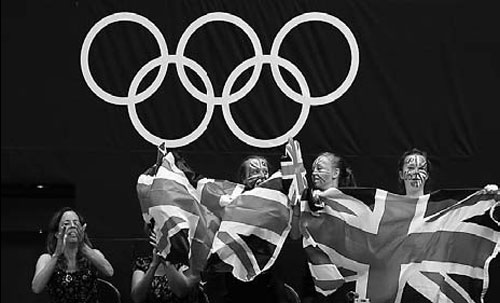
Spectators wave British flags to cheer for Britain's Francesca Jones during the rhythmic gymnastics competition at the London Olympics. [Photo/Agencies] |
Reuters in London

Medal Count |
||||
| 1 |  |
46 | 29 | 29 |
| 2 |  |
38 | 27 | 22 |
| 3 |  |
29 | 17 | 19 |
| 4 |  |
24 | 25 | 33 |
| 5 |  |
13 | 8 | 7 |
| 6 |  |
11 | 19 | 14 |


Most Viewed

Gold medal moments
Age not a problem for Olympic dreams
Olympic moments to remember
Beijing Olympics just keeps on giving
Against the Olympic spirit
Olympic fashion tips
Taking success overseas
Competition Schedule