London mascot maker feels pinch of rising labor costs
Updated: 2012-08-04 04:16:18
By Cheng Yingqi ( China Daily)
|
|||||||||||


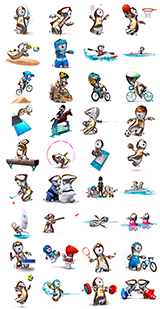
Gu Feng, whose company has made around 500,000 sets of Wenlock and Mandeville, the London 2012 Olympic Games mascots, is worried as he looks ahead to the 2016 Games in Brazil.
The 55-year-old chairman of Yancheng Rainbow Arts and Crafts Co in East China's Jiangsu province said his plant is under pressure because of workers' pay rises and the depreciation of the US dollar.
Although this should be the peak season for selling toys, Gu's plant is not busy because of a shortage of new orders — except for the Olympic ones.
"We were lucky to get the Olympic orders this year. But who knows what will happen four years later in Rio de Janeiro?" he said.
"I mean, if the franchisee emphasizes nothing but low price, we might lose our advantage to the Southeast Asian countries where labor costs are low."
Gu started Rainbow 15 years ago, and it is now the oldest toy plant in the city of Yancheng. Other toy plants that opened during the same period have closed down.
"When I started Rainbow, I had only 12 workers and seven sewing machines," Gu said. "But the export demand was great, and we expanded quickly."
His business enjoyed enormous growth between 2002 and 2008, when market rules and the logistics system were improved in Yancheng, a coastal city. In 2008, the plant had 157 million yuan ($24.64 million) in export sales.
In the 2010 Olympic Winter Games in Vancouver, Canada, Gu sold 2 million stuffed mascots.
"When the mascot was unveiled, the organizing committee did not give out the manufacturing design, which meant we had to design the toy based on the image by ourselves," Gu said.
The design process was expensive. Gu's designers changed a number of molds for example, to find a proper nose for the mascot, and each mold cost 3,000 yuan.
"Making the samples of a mascot named 'Mukmuk' alone cost over 50,000 yuan. We send the samples to Vancouver for adaptation, and it took more than 20 attempts to reach a satisfying result," he said.
Gu said the prolonged design process might have scared away some plants, but the experience helped him to win the order in London.
"Lucky for us, the franchisee of the London Games, a company named Golden Bear, focuses more on quality rather than the extra 2 or 3 yuan (apiece) they will pay," Gu said.
He sent a design team to London to discuss and determine the toy design, and after receiving a Golden Bear inspection team, obtained the order in a few months.
However, things did not go as smoothly as Gu hoped they would. In January, a UK newspaper, The Sun, accused the company of using slave labor, saying it forced workers to put in 358 hours a month and while paying only $145.74. But Gu said the report was not true.
"The salary of our workers is $300 to $400 a month, and actually, you cannot find any workers for your plant in Yancheng lower than that price. And we had never forced the workers to work long hours," he said.
The wage surge is not unique to Yancheng. In fact, labor costs shot up 20 percent each year for the past four years, and China's coastal provinces are losing their power to find workers, according to a recent report in The Economist.
"We can see the trend that more and more manufacturing is moving to other countries and regions — more and more textiles industry to Bangladesh, Sri Lanka, Thailand — where the cost of manufacture is much lower, whereas electronic products move to Taiwan and Malaysia," said Graeme Read, group managing director of Antal International, a global executive recruitment organization.
But Read also said that in comparison with other countries in the region, China still retains a manufacturing advantage in terms of better logistics and an abundant labor force with engineering diplomas, and China manufacturing is moving up the value chain.
Gu said some toy plants in Yancheng moved to central China, and some moved to other countries.
He added his business setup in Jiangsu has both advantages and disadvantages.
"Because the industrial chain is complete here, from a button on the toy to the packing case, you do not have to waste time buying the smallest parts."
"But I know I will have to move sometime anyway. It is the trend."
Gu said he has considered moving to other industries, but that takes time.
"For example, I tried to invest in photovoltaic material, but ended up losing money. Now I wish I had chosen real estate instead of toys when I started my own business 15 years ago."
Contact the writer at chengyingqi@chinadaily.com.cn
Related Stories
London gets a taste of Olympics 2012-07-24
London Olympic mascot named after small town 2012-07-18
Chinese factory makes London Olympics mascots 2012-06-21
Olympic mascot maker rejects sweatshop claims 2012-02-08
Photo Gallery








Medal Count |
||||
| 1 |  |
46 | 29 | 29 |
| 2 |  |
38 | 27 | 22 |
| 3 |  |
29 | 17 | 19 |
| 4 |  |
24 | 25 | 33 |
| 5 |  |
13 | 8 | 7 |
| 6 |  |
11 | 19 | 14 |


Most Viewed

Gold medal moments
Age not a problem for Olympic dreams
Olympic moments to remember
Beijing Olympics just keeps on giving
Against the Olympic spirit
Olympic fashion tips
Taking success overseas
Competition Schedule