Trampoline
Updated: 2012-05-15 10:05:32
(london2012.com)
|
|||||||||||


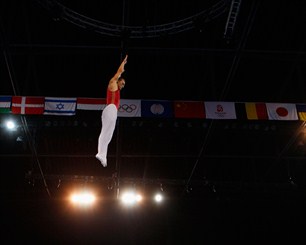
Prepare to be dazzled by the athletes in the Trampoline competition at the London 2012 Games, the newest of the three Gymnastics disciplines on the Olympic program.
Devised in the 1930s at the University of Iowa, the first modern trampoline was initially used as a training tool for tumblers, astronauts and athletes. However, it grew in popularity to such an extent that in 1964 the first ever Trampoline World Championships were held at the Royal Albert Hall in London.
Since making its Olympic debut at the Sydney Games in 2000, the sport has consistently featured awe-inspiring displays of acrobatic excellence, with athletes jumping to heights of up to 10 metres.
 |
Competition dates
Aug 3 - 4
Competition venue
North Greenwich Arena
Number of medal events
Two - men's and women's competition
Number of competitors
32 (16 men and 16 women). Each country is limited to two men and two women
Field of play
The field of play contains two trampolines next to each other, 2m apart and both just 10m away from the judging panel. Each trampoline is 5.05m long, 2.91m wide and 1.155m high. The bed is woven from strips that are less than 6mm thick, and is attached to the frame with more than 100 steel springs.
History of Trampoline at the Olympic Games
Trampoline Gymnastics is a relative newcomer on the Olympic programme; it made its debut at the Sydney 2000 Games.
The basics
Gymnasts perform a series of 10 skill routines, with a variety of single, double and triple somersaults with and without twists. Precise technique and perfect body control are vital for success, with judges delivering marks for difficulty, execution and time of flight, minus penalties.
Competition format
Each competition for men and women features two phases: the qualification round and the final round. Athletes perform two voluntary routines in the qualification round: in the qualification round, the first routine (with two skills counting for difficulty) focuses on simplicity and excellent execution, while the second exercise has no difficulty limitations. The eight athletes with the best scores advance to the final for one more voluntary routine of 10 different skills, which determines the results of the competition.
Officials
Eleven judges watch the routine and award scores for difficulty, execution and time of flight. Marks are taken off for infringements and errors.
Keys to success
Athletes are judged against a strict set of criteria where every part of the routine must be as near to perfection as possible. The angle of the limbs, the position of the feet, the moves and finish must all be of the highest standard.
Breaking the rules
As well as being judged against an exacting set of criteria, where poor execution will lose points, athletes can also be penalised for taking too long to start their routine, or major infringements such as landing on the frame of the trampoline.
Jargon buster
Barani - a front somersault with a half-twist.
Fliffus - a double somersault with at least a half-twist.
Triffus - a triple somersault with at least a half-twist.
Rudolph - a front somersault with 1? twists, sometimes known as a 'Rudy'.

Medal Count |
||||
| 1 |  |
46 | 29 | 29 |
| 2 |  |
38 | 27 | 22 |
| 3 |  |
29 | 17 | 19 |
| 4 |  |
24 | 25 | 33 |
| 5 |  |
13 | 8 | 7 |
| 6 |  |
11 | 19 | 14 |


Most Viewed
Gold medal moments
Age not a problem for Olympic dreams
Olympic moments to remember
Beijing Olympics just keeps on giving
Against the Olympic spirit
Olympic fashion tips
Taking success overseas
Competition Schedule