Canoe Sprint
Updated: 2012-05-14 16:26:31
(london2012.com)
|
|||||||||||


Requiring sustained bursts of speed and power, Canoe Sprint at the London 2012 Games will offer thrilling, down-to-the-wire finishes.
The histories of the canoe and the kayak go back hundreds of years, but it wasn't until the middle of the 19th century that the first official canoe and kayak races were held. At the Olympic Games, the sport now takes two forms, the older of which is the power-packed, fiercely competitive Canoe Sprint discipline - head-to-head races over still water.
 |
Competition dates
Aug 6 - 11
Competition venue
Eton Dorney, Buckinghamshire
Number of medal events
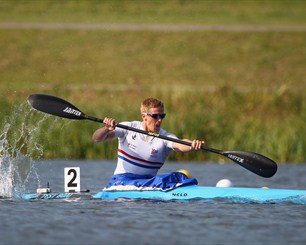
12 - men's and women's events covering distances of 200m, 500m or 1,000m, either solo, in pairs or in crews of four. Two types of boats are used: canoes, in which athletes use a single-bladed paddle from a kneeling position; and kayaks, in which the competitors sit in the boat and use a paddle with two blades.
Number of competitors
246 (158 men and 88 women). Each country is limited to one boat in each event, which equates to a total of 18 athletes (12 men and six women) across all events.
Field of play
The lake at Eton Dorney is 2,200m long, with nine lanes. However, only eight lanes will be used for Olympic competition (unless a tie in a qualifying race results in a ninth boat progressing to the next round). Athletes race over distances from 200m to 1,000m.
History of Canoe Sprint at the Olympic Games
Canoeing first featured as a demonstration sport at the Paris 1924 Games. It became a full Olympic sport in 1936, when races were held over distances of 1,000m and 10,000m. Since then, the Olympic events have shortened: the 10,000m events were last held at the Melbourne 1956 Games.
The basics
Canoe Sprint events are head-to-head races conducted on still water, as opposed to the white-water time trials of the Canoe Slalom competition. In canoes, athletes race single (men's C1) or in pairs (men's C2). In kayaks, athletes race either single (men's K1 and women's K1), in pairs (men's K2 and women's K2) or in fours (men's K4 and women's K4).
Competition format
The format of the competition depends on how many boats are competing.
In events with 10 boats, the competition starts with two heats. The winner of each heat goes straight into the final, with the rest going forward to one semi-final. The best six boats from the semi-final progress to the final.
Events with 11 to 16 boats start with two heats.
If there are 11 to 12 boats competing, the winning boat from each heat progresses straight to the A final, with the other boats going forward to the semi-finals. The top three boats from each semi-final progress to the A final, while the others advance to the B final (which ranks boats from nine through to 16).
If there are 13 to 14 boats competing, the first five boats in each heat progress to two semi-finals, while the other boats go to the B final. The top four boats from each semi-final progress to the A final, while the others progress to the B final.
If there are 15 to 16 boats competing, the first six boats in each heat progress to two semi-finals, while the other boats go to the B final. The top four boats from each semi-final progress to the A final, while the others progress to the B final.
Events with 17 to 24 boats start with three heats. The first five boats in each heat plus the boat with the best sixth-placed time progress to two semi-finals, while the other boats are out of the competition. The top four boats from each semi-final progress to the A final, while the others progress to the B final.
Officials
Officials include a chief judge, timekeepers, aligners, start judges, finish judges, boat control officials and umpires.
Keys to success
Canoe Sprint depends on immense core and upper-body strength, as well as great stamina. Technique is vital too, to ensure getting the maximum out of every stroke.
Breaking the rules
Athletes can be penalised for infringements such as a repeat of a false start or leaving the middle of their lane. A boat that capsizes before the bow crosses the finish line will also be eliminated from the race.
Jargon buster
Bow - the front of the craft.
Stern - the rear of the craft.
Paddler - an athlete in a canoe or kayak.
Start gate - the 'boot' in which the bow of the boat sits before the start of a race.
Stroke rate - the number of paddle strokes per minute.




Medal Count |
||||
| 1 |  |
46 | 29 | 29 |
| 2 |  |
38 | 27 | 22 |
| 3 |  |
29 | 17 | 19 |
| 4 |  |
24 | 25 | 33 |
| 5 |  |
13 | 8 | 7 |
| 6 |  |
11 | 19 | 14 |


Most Viewed
Gold medal moments
Age not a problem for Olympic dreams
Olympic moments to remember
Beijing Olympics just keeps on giving
Against the Olympic spirit
Olympic fashion tips
Taking success overseas
Competition Schedule