
Taekwondo
Updated: 2012-05-14 18:18:59
( london2012.com)
|
|||||||||||


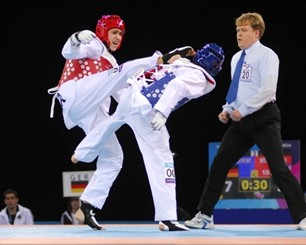
Expect plenty of excitement at ExCeL when the Taekwondo competitors take to the court at the London 2012 Olympic Games.
The word Taekwondo translates into English as the way of foot and fist - an accurate description of the principles behind this Korean martial art. Powerful kicks and punches are, literally, the name of the game, which offers tension, drama and plenty of action.
 |
Competition dates
Aug 8?-?Aug 11
Competition venue
ExCeL
Number of medal events
Eight - four weight categories for men and four for women.
Number of competitors
128?(64 men and 64 women). Each country is limited to two men and two women across all events, and to only one athlete in any particular event.
Field of play
Taekwondo contests are fought on a court measuring 8m x 8m.
History of Taekwondo at the Olympic Games
Taekwondo made its debut as a demonstration sport at the Seoul 1988 Games, but was not officially added to the Olympic programme until the Sydney 2000 Games.
The basics
The object of Taekwondo is to land kicks and punches on the opponent's scoring zones: one point is awarded for a valid attack to the trunk protector, two points for a valid turning kick to the trunk protector, three points for a valid kick to the head, and four points for a valid turning kick to the head.
Each contest is made up of three two-minute rounds. Over their standard white uniform, known as a dobok, competitors wear coloured protective equipment. The competitor wearing blue is referred to as chung, while the competitor in red is hong.
Competition format
In each weight category, the competition consists of a single elimination tournament.
The winners of each contest qualify for the next round, with the two finalists going head to head in the gold medal contest. All competitors who lose to one of the finalists at any stage of the competition enter the repechage. The two semi-final losers meet the winners of the two repechage pools; these matches determine the winners of two bronze medals.
Officials
A referee stays in the combat area, while corner judges sit at each corner of the court. The judges award points for valid kicks and punches that are recorded electronically.
Keys to success
Athletes in Taekwondo need strength and stamina as well as excellent technical ability in order to make every punch and kick count for points.
Breaking the rules
Infringing the rules can see valuable points awarded to the opposition. Penalties range from Kyong-go (a warning penalty) for acts such as crossing the boundary line, hitting below the waist or using the knee to attack. Two Kyong-go warnings result in a point being awarded to the opponent. More seriously, a Gam-Jeom (deduction penalty) is given for actions such as attacking a fallen opponent, or intentionally attacking the face. A Gam-Jeom results in a one-point deduction.
If an athlete receives four penalty deduction points, the contest is stopped and the opponent is declared the winner.
Jargon buster
Chung - the competitor wearing blue
Dobok - a competitor's uniform
Hong - the competitor wearing red Shi-jak - the command to start fighting
Gam-jeom - a deduction penalty







Medal Count |
||||
| 1 |  |
46 | 29 | 29 |
| 2 |  |
38 | 27 | 22 |
| 3 |  |
29 | 17 | 19 |
| 4 |  |
24 | 25 | 33 |
| 5 |  |
13 | 8 | 7 |
| 6 |  |
11 | 19 | 14 |


Most Viewed

Gold medal moments
Age not a problem for Olympic dreams
Olympic moments to remember
Beijing Olympics just keeps on giving
Against the Olympic spirit
Olympic fashion tips
Taking success overseas
Competition Schedule