Swimming
Updated: 2012-05-14 17:56:40
( london2012.com)
|
|||||||||||


Hugely popular around the world as a leisure activity and a competitive sport, Swimming has featured at every modern Olympic Games. Other than the Marathon Swimming 10km event, held in the Serpentine in Hyde Park, the Swimming competition will take place in Aquatics.
Speed, strength and stamina will be key for athletes in the competition which features no fewer than 34 medal events.
 |
Competition dates
July 28 - Aug 4
Competition venue
Olympic Park - Aquatics Center (Swimming) Hyde Park (Marathon Swimming)
Number of medal events
34 - 16 men’s and 16 women’s events in the pool, plus two Marathon Swimming events
Number of competitors
950 (900 in pool events, 50 in Marathon Swimming). Each country is limited to two athletes in each individual event and one team in each relay event.
Field of play
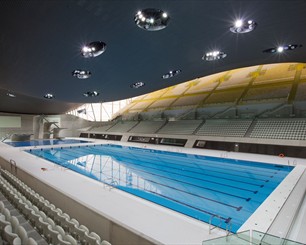
The swimming pool is 50m long, 25m wide and 3m deep. It is divided into 10 lanes, although only the centre eight are used for competition.
History of Swimming at the Olympic Games
At the first few modern Olympic Games, Swimming events were held in open water. At Paris in 1900, for instance, they took place in the River Seine. However, the rules were formalised in 1908, when the London Games staged the first Olympic Swimming competition to be held in a pool. Women’s events were introduced at the Stockholm 1912 Games.
The basics
There are four strokes used in Olympic competition: Freestyle (essentially, front crawl), Backstroke, Breaststroke and Butterfly. All four strokes feature in the Individual Medley and Medley Relay events. Swimmers also compete in the Freestyle Relay events.
Olympic races in the pool are conducted over a variety of distances, from 50m (one length of the pool) all the way up to 1500m (30 lengths). The first athlete to touch the electronic finishing touchpad at the end of the pool in each race is the winner.
Competition format
Races start with heats, the number of which depends on the number of swimmers in the event. Swimmers are seeded according to FINA rules, based on the final entry lists. These seedings are used to determine the heat each swimmer starts in - the top seeds are placed in different heats. Seedings are also used to determine the lane each athlete swim in - the higher the seeding, the closer to the centre lanes of the pool.
For 50m, 100m and 200m events, the top 16 swimmers from the heats progress to the semi-finals, and the top eight from these compete in the final. As in the heats, the swimmers’ seedings are used to decide which semi-final they swim in and which lane they are allocated. In 400m, 800m, 1500m and relay events, swimmers progress from the heats straight to the final.
Officials
Swimming events need many officials including timekeepers, start and finish judges, stroke judges, turn judges and an overall chief referee who is in charge of the competition.
Keys to success
For all events, getting a good start is paramount. Different events have different starts, either by diving in or starting in the water. Good stroke technique can make the difference between winning and losing, as can making fast turns and a good finish. The winning swimmers should have all parts of their race technique honed to perfection, including the changeovers in the Relay events.
Breaking the rules
While the start for all swimmers is crucial, a false start results in disqualification. Judges also look closely to check that stroke and turning techniques are legal and that in the Relay events each swimmer touches the end of the pool before his/her teammate leaves the starting blocks. Infringements of any kind are reported to the chief referee, who decides on any penalty to impose.
Jargon buster
Long course - a 50m pool of the type used in Olympic competition, as opposed to a short course measuring 25m.
Medley - a combination event in which a swimmer or team swims separate legs of backstroke, breaststroke, butterfly and freestyle.
Negative split - when an athlete swims the second half of a race faster than the first half.
Open turn - a type of turn in which swimmers must touch the end of the pool with their hands.
Tumble turn - an underwater roll at the end of a lap, which allows swimmers to push off from the end of the pool with their feet.




Medal Count |
||||
| 1 |  |
46 | 29 | 29 |
| 2 |  |
38 | 27 | 22 |
| 3 |  |
29 | 17 | 19 |
| 4 |  |
24 | 25 | 33 |
| 5 |  |
13 | 8 | 7 |
| 6 |  |
11 | 19 | 14 |


Most Viewed

Gold medal moments
Age not a problem for Olympic dreams
Olympic moments to remember
Beijing Olympics just keeps on giving
Against the Olympic spirit
Olympic fashion tips
Taking success overseas
Competition Schedule