Short-distance shuttling
"We want to encourage residents to choose public transport and use bikes to shuttle between bus and subway stations. For short distances, cycling or walking are the only realistic methods of transport," said Zhao Jie.
Along with Mexico City, Beijing topped the list of the world's worst places for commuting, according to a 2011 survey of 20 cities, conducted by IBM. "Buses, subways, bikes and walking: The public transport system should be more widely used, rather than building more overpasses or widening the roads for cars," he said.
 |
|
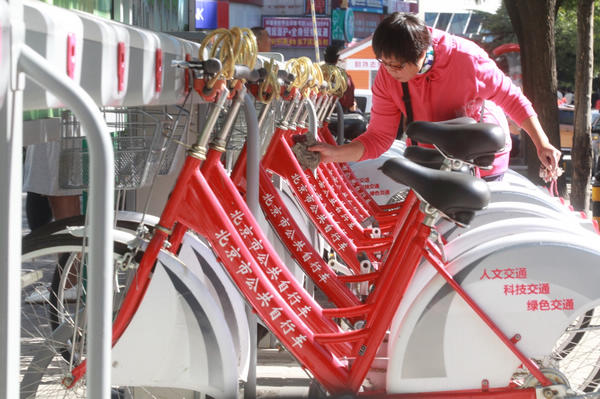
A woman inspects bikes at a rental station in Beijing. Fu Ding / for China Daily |
Currently, bikes account for about 16 percent of the traffic flow in Beijing, a decline from the 30 percent recorded in 2005. "If the percentage falls below 5, there won't be any way of rescuing the city," he added. "We can only say that Beijingers have a very good history of liking and riding bikes and all we need is to improve the facilities, awaken people's consciousness and regulate the rules for bike use."
In an attempt to reduce car use, the government introduced a "car-free" day in 2007. In the first year, 110 cities took part in the September event. This year, the number was 149.
In 2010, 32.5 percent of car journeys were shorter than 5 km, 1.5 percent more than in 2005, according to the Beijing 4th Comprehensive Transport Survey Summary Report in 2011.
The rise of the car
The humble bicycle was once the dominant mode of transport in Beijing, but the roadmap of what was once one of the world's best cities for cyclists has changed: "Some people choose not to ride a bike because of the urban traffic design, which is no longer suitable for cycling," said Zhao Liman.
As the number of cars on the capital's streets rose, motorists began using the city's dedicated bike lanes as parking lots, narrowing the room available and resulting in insecurity among cyclists.
"Exploiting the bike lanes is one of our top priorities," said Liu Changge, deputy director of Beijing Municipal Roadway Administration Bureau. Around 90 percent of the city's main roads have bike lanes, but there are few on secondary roads, according to a survey conducted by the bureau.
The bureau is now attempting to regulate motorists' use of bike lanes, arguing that such use should either be outlawed or limits should be imposed on the length of time people are allowed to park in them.


Copyright 1995 - . All rights reserved. The content (including but not limited to text, photo, multimedia information, etc) published in this site belongs to China Daily Information Co (CDIC). Without written authorization from CDIC, such content shall not be republished or used in any form. Note: Browsers with 1024*768 or higher resolution are suggested for this site.
License for publishing multimedia online 0108263 Registration Number: 130349