Wen Jiabao vows country will play a greater role in the promotion of the green agenda. Chen Weihua reports from Rio de Janeiro.
With its traffic snarl-ups, shantytowns and the breathtaking views from atop Corcovado Mountain with its giant statue of Jesus Christ, the Brazilian city of Rio de Janeiro — the venue of the United Nations Conference on Sustainable Development, or Rio+20 — is a study in the contrasts and challenges facing sustainable development and a better future.
 |
|
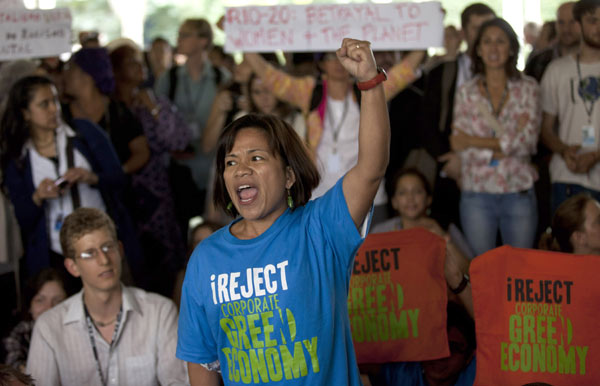
An environmental activist chants slogans at Riocentro, the venue of the United Nations Conference on Sustainable Development, or Rio+20, in Rio de Janeiro on June 21. Victor R. Caivano/AP |
At the conference, which ended on June 22, the global picture for sustainable development looked depressing. The challenges facing the planet are the most critical in history: pollution, poverty, the population explosion, climate change, desertification, inequality and the loss of biodiversity. Yet, the greatest challenge of all appeared to be the lack of strong global will to accept responsibility and tackle the crisis.
A large part of the problem was that both developing and developed economies were simply not on the same page. While developed nations pushed for a greener economic structure, many developing countries put the reduction of poverty at the top of their agenda, along with other basic social and economic programs. Some believe that developed countries and major corporations are using the green economy as an excuse to pursue profits and manipulate the global economy.
Happy versus unhappy
From the outset, the focus of Rio+20 was the outcome document called The Future We Want, an initiative that is supposed to pilot the world on a path to sustainable development.
However, despite a year of negotiations and days of horse-trading at the conference, nations ultimately remained sharply divided on the text. The Brazilian government, which was responsible for pushing the document through the 193 nations, had to present a watered-down version to ensure it passed prior to the arrival of heads of state and government leaders for the summit. The resulting document prompted both praise and criticism from the 45,000-plus people attending the mega-conference.
The UN hailed the final agreement, saying that it will advance action on sustainable development. Governments, civil society, multilateral development banks and businesses all pledged to help shape a more sustainable future.
UN Secretary-General Ban Ki-moon, who earlier had harsh words about the international community's lack of commitment, described Rio+20 as providing a solid platform on which to build. "Rio+20 has affirmed fundamental principles, renewed essential commitments, and given us a new direction," he said.
Brazil's President Dilma Rousseff called the outcome document "a great step forward", adding "I am convinced that this conference will have the effect of bringing about sweeping change."
Sha Zukang, secretary-general of Rio+20 and UN undersecretary for economic and social affairs, was also full of praise: "I have not the slightest doubt that the outcome document you have adopted will provide an enduring legacy for this historic Rio+20 conference: The Future We Want," he said.
"You, the world's leaders, have renewed your political commitment to sustainable development. You signed up to a framework for action that will drive us forward. Together, we can take great pride in this extraordinary accomplishment," added Sha.
However, despite the official pronouncements, on the final day of the conference Sha was forced to admit that no one was happy with the outcome. "Our job is to make everyone equally unhappy. If one party is happy and others are not happy, then no, he won't be happy either. Equally unhappy means equally happy," he said.
One decidedly unhappy sector consisted of NGOs, which voiced their frustration about the outcome document and the conference.
CARE, a humanitarian organization that fights global poverty, said Rio+20 had failed those most in need. "Millions of poor people now have to pick up the pieces from the mess the world leaders left behind here in Rio. World leaders did not come to Rio prepared, and (they) failed to deliver any clear vision or solutions to eradicate poverty and stop environmental degradation," said Kit Vaughan, CARE's coordinator of climate change advocacy.
Jim Leape, director-general of the World Wildlife Fund, said Rio+20 was a conference "to address the pressing challenge of building a future that can sustain us".
"Unfortunately, the world leaders who gathered here lost sight of that urgent purpose. The result is a squandered opportunity — an agreement that does not set the world on a path toward sustainable development," he said.

Copyright 1995 - . All rights reserved. The content (including but not limited to text, photo, multimedia information, etc) published in this site belongs to China Daily Information Co (CDIC). Without written authorization from CDIC, such content shall not be republished or used in any form. Note: Browsers with 1024*768 or higher resolution are suggested for this site.
License for publishing multimedia online 0108263 Registration Number: 130349