Regulations eased
The past few years have seen Shenzhen, Shanghai and Beijing ease the regulations to some extent, but many organizations still have their applications rejected. For instance, Maple submitted all the necessary paperwork to the local authority early last year, but so far has received no reply.
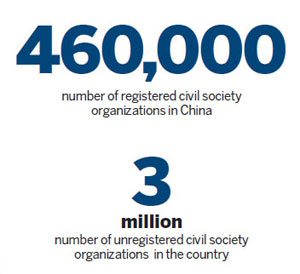
China currently has approximately 460,000 registered civil society organizations, but another 3 million remain unregistered, according to Wang Ming from the NGO Research Center.
The problem is that if an organization isn't registered as an NGO, it is required to pay tax on the public funds and donations it receives at the same rate as a business.
Also, successful registration as an NGO is always a precondition of applying for the government-financed outsourcing program. As a result, many organizations, that have provided good services to the local community for years, are disbarred from participation in the program.
"The existing registration policy really shuts out a lot of NGOs that are able to deliver quality services. It's a pity," said Wang from the Beijing Social Construction Office.
On a positive note, in 2011 Guangdong province announced that as of July 1, all the NGOs in the region will be able to register directly without needing to find an official supervising body. The local government announcement noted that "special fields are an exception", but no details were disclosed. Moreover, the provincial government at all levels will be allowed to outsource public services to NGOs.
In March, the minister of civil affairs, Li Liguo, threw his weight behind the scheme and predicted its expansion in the years to come.
"In the past, we saw NGOs in a very political way. Nongovernmental organizations were seen as a threat to the government, one that could lead to instability. The fact that they provide much-needed public services has been largely ignored," said Wang Zhenyao, director of the Philanthropy Research Institute at Beijing Normal University.
Until 2010, he was a senior official at the Ministry of Civil Affairs, and he has sensed a change in the prevailing attitude when talking to his "old friends and colleagues".
"I think they now realize how helpful NGOs can be and that it's a wise choice to cooperate with them, rather than be suspicious of them," he said.
Lottery funding 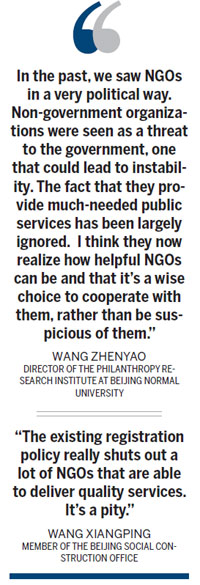
Another potential breakthrough would the inclusion of funds for outsourcing in the local fiscal budget, in place of the current system where the money comes from the national lottery foundation. "Inclusion in the budget would make outsourcing more consistent and would probably result in an upgrading of the scale of work, thus allowing NGOs to earn more," according to Wang Zhenyao.
"The fiscal revenue comes from the taxpayers and purchasing the best services for them is a highly efficient way of paying back," he said.
Wu Qunfang doesn't really care whether the money comes from the fiscal budget or the lottery fund, she just hopes the amount will increase. Government payments currently account for less than 10 percent of her organization's annual income.
"I've visited NGOs in Hong Kong and Taiwan and the financial support provided by their authorities is up to 60 percent. And that frees them from the task of finding new donors every year. I'm really jealous," said the 44-year-old, who takes her own laptop to work because the computer in her office is in such poor condition.
Wang Puqu, a professor at the Peking University School of Government, said the outsourcing of public services is still in its infancy in China. Transparency in the selection process and the program evaluation and monitoring system lag behind those in advanced economies and regions, which have more 20 or 30 years of experience in this field.
"But the good thing is that we've taken the first step," said Wang Ming from the NGO Research Center.
"In China, once ideas change, practices will follow pretty quickly. And as both the government and the public will benefit from the new trend, I think it will continue to flourish," said Wang Zhenyao from Beijing Normal University.
Contact the reporter at tangyue@chinadaily.com.cn

Copyright 1995 - . All rights reserved. The content (including but not limited to text, photo, multimedia information, etc) published in this site belongs to China Daily Information Co (CDIC). Without written authorization from CDIC, such content shall not be republished or used in any form. Note: Browsers with 1024*768 or higher resolution are suggested for this site.
License for publishing multimedia online 0108263 Registration Number: 130349