China is fast emerging as the common factor in all these expansion plans and all eyes are fixed on the rapidly growing hospitality market in the world's second-largest economy.
Lodging Econometrics reported that as of the first quarter of 2011, China had 1,260 projects with 353,254 rooms in the pipeline, accounting for 62 percent of the region's total projects and 70 percent of its rooms.
"Expansion in Asia has definitely helped our bottom line," said Eikon Ito, JAL Hotels' director of project planning & development. "It isn't only the revenue from the hotels that's important to us. It is also about building brand recognition with travelers, so that when visitors come to Japan or to other Asian markets where we have properties, they are familiar with our Nikko Hotels brand."
However, while China continues to attract the lion's share of growth, other Asian hotel companies also have their sights trained on home turf and the Middle East.
|
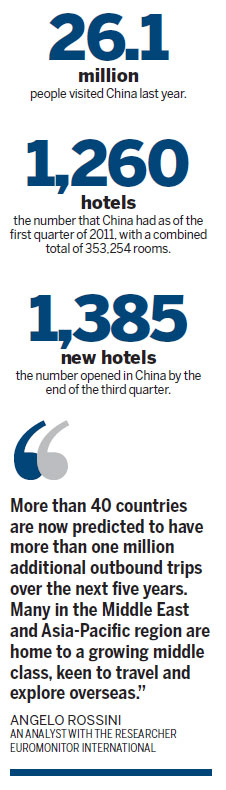 |
"More than 40 countries are now predicted to have more than one million additional outbound trips over the next five years. Many in the Middle East and the Asia-Pacific region are home to a growing middle class, keen to travel and explore overseas," said Angelo Rossini, an analyst with the researcher Euromonitor International.
The Singapore-listed luxury resort operator Banyan Tree spotted the spending power of Asian consumers as early as 2000. "When we started, most of our guests were either Europeans or Americans. By mid-2000, luxury travel from Asia started to outpace the traditional markets of Europe, Japan and the US, which in 2006 contributed close to 70 percent of our revenues," said Luca Deplano, Banyan Tree's vice-president of marketing. "Now, roughly half come from Western countries and half from the ranks of the newly affluent Asian middle class."
Picking up on the same trend, Shangri-La will put 12 new properties into Asia and the Middle East, while Furama Hotels International aims to expand in the Chinese mainland and Taiwan, as well as Indonesia and Thailand. Dusit is also moving in a similar direction: Catherine McNabb, vice-president of sales & marketing, said the group is focusing on Southeast Asia and is also exploring opportunities in the Middle East.
For JAL Hotels, Southeast Asian countries are the target: "We chose to focus on this region because it has expanding economies, which will create a greater need for hotel development," said Ito.
Another rising giant is India. According to Lodging Econometrics, the country had the region's second-largest hotel project in development and the third-largest in the world as of the first quarter of 2011 and Asian companies are already making tentative forays into the market. Singapore's Frasers Hospitality is set to open three new properties in the southern metropolis of Bengaluru. Meanwhile, The Ascott and Shangri-La both have plans for the country. "In this industry, a lot depends on the ability to foresee the future and move in first. If you are three years ahead of the closest competitor, you are in a much better position to get better returns. It's really how far ahead you can see," explained Shangri-La's Kent Zhu, director of sales and marketing.
In recent years, Asian hotel companies have also started venturing into Europe and the US. Mandarin Oriental hotels are already in many prominent European and US cities. Fraser Hospitality has properties in Europe. Shangri-La debuted in Paris last year and will soon open in London and Istanbul. Meanwhile, Banyan Tree is planning to enter Greece, Montenegro and Portugal.
Western locations are necessary to build a global business, according to Deplano: "The hotel industry is global in nature - our resorts and spas are located in 28 countries with a third of our guests coming from Asia, a third from Europe and the US, and a third from the rest of the world - so positioning ourselves as a global niche player steeped in the Asian tradition is strategic."
"These markets deliver brand presence for us. Although they will not offer the same level of profitability as the Asia-Pacific region because of higher operating costs, it is important for us to show Europe and North America what Shangri-La is all about. That value cannot be measured," explained Zhu.


Copyright 1995 - . All rights reserved. The content (including but not limited to text, photo, multimedia information, etc) published in this site belongs to China Daily Information Co (CDIC). Without written authorization from CDIC, such content shall not be republished or used in any form. Note: Browsers with 1024*768 or higher resolution are suggested for this site.
License for publishing multimedia online 0108263 Registration Number: 130349