|
 |
|
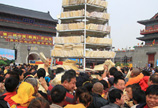
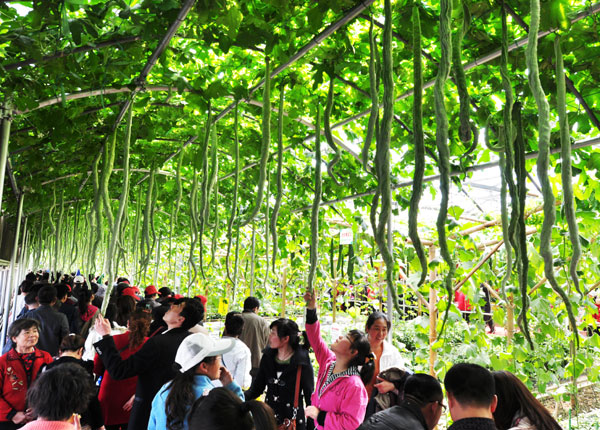
People visit a vegetable expo held in Shouguang, Shandong province in April. Dong Naide / for China Daily |
A speedy response
The world's top 10 seed companies, including Switzerland's Syngenta, the Netherlands' Rijk Zwaan and Israel's Hazera, are active players in the Chinese market. They have set up breeding bases or research facilities in Shouguang.
In July 2009, when tomato yellow leaf curl virus overran the greenhouses in Shandong, not one Chinese seed businesses could provide a timely solution, Tang said.
Hazera Genetics, which entered China in 1999, provided tomato varieties resistant to the virus within a few weeks, allowing local growers to re-sow soon, said Yossi Tzuri, Hazera China's CEO.
The price of the virus-resistant seeds and strains was more than double that for earlier versions of tomato, Tang said.
This anecdote and others are so deeply rooted in the minds of some local growers that they have grown to distrust Chinese vegetable brands, said Shen Huolin, dean of the vegetable science department at China Agricultural University in Beijing.
|
|
After 12 years of research and development, the professor and his team cultivated a premium long horn-shaped chili pepper variety, known as Zhongshou-12, that is proven better than its foreign counterparts in product quality and resistance to pests and disease.
"When a zealous farmer came to me for more seeds after a trial run," Shen said, "I offered a discount, which was half the price of foreign pepper seeds. To my chagrin, he said that since it was not a foreign make, the price should be still lower!"
Use and value up
China's mammoth vegetable sector used nearly 100,000 tons of seeds to produce 650 million tons of vegetables last year, according to Liao Xiyuan, deputy chief of Ministry of Agriculture's seed management bureau.
The influx of foreign seeds has been rising, Liao said. By December 5 this year, for example, the import value hit $121 million - 3.1 times the value in 2004, Liao cited Customs figures as saying.
"The majority of Chinese greenhouse vegetable seed companies are not capable of breeding and producing seeds or possessing copyright varieties," said another bureau official, who preferred unidentified. "They are mainly agents or producing and marketing some conventional seeds."
He said that overseas seed companies have grabbed 15 percent of the Chinese greenhouse vegetable market and nearly 20 percent in Shandong.
Foreign seeds are usually several or dozens of times more expensive than the homebred, he said. That explains why the value of Chinese seeds, which hold 80 percent of the Shandong market, equals just 20 percent of the imported seeds' value.
Because foreign seeds boast higher germination rates and promise good results, local seedling companies would buy them regardless of the price, said Wang Rui, an executive with New Century Breeding Co in Shouguang.


Copyright 1995 - . All rights reserved. The content (including but not limited to text, photo, multimedia information, etc) published in this site belongs to China Daily Information Co (CDIC). Without written authorization from CDIC, such content shall not be republished or used in any form. Note: Browsers with 1024*768 or higher resolution are suggested for this site.
License for publishing multimedia online 0108263 Registration Number: 130349